Tag: CoreConfidence Optimism Hope Resilience SelfEfficacy

  • Narratives in Neuroscience (Pt1) An Integrative Literature Review

    Narratives in Neuroscience (Pt1) An Integrative Literature Review

    What fMRI analysis of the Default Mode Network
    can reveal about the impact of Stories on the Human Brain

    Introduction

    Narratives are increasingly being used in neuroscience as naturalistic stimuli for studies employing Functional Magnetic Resonance Imaging (fMRI) analysis to examine the regions of the brain collectively known as the Default Mode Network (DMN). Using naturalistic stimuli ensures these studies have sound ecological validity, and fMRI analysis provides robust quantitative evidence validating the importance of narratives in healthy socioemotional development – a bond that has previously been largely demonstrated using qualitative studies. Thus results from these studies provide an untapped pool of empirical evidence demonstrating the relationship between narratives and social and emotional development.

    When taken together these studies suggest that the role of narratives in this relationship is not incidental; rather that narratives, language, and self- and social-awareness are interdependent and have developed as an evolutionary triptych, central to the evolution of the human DMN and its role in the unique ability of humans to accumulate and share knowledge. Reinterpreting studies of narratives in neuroscience through an educational lens reveals the potential for stories to enhance self-actualisation in children and adolescents, especially in reading programs such as those encompassing Developmental Bibliotherapy. This novel approach provides a framework by which existing fMRI analysis can provide a source of empirical evidence for a broader investigation into the importance of narratives in adolescent wellbeing and education. [GO BACK]

    Stories and Personality

    Storytellers and their audiences know how stories can influence and change our view of ourselves, others and the world. Stories, or narratives, reveal how interrelated events, unfolding over time affect the fortunes and relationships in the lives of the story’s characters. Narratives often contain moral or didactic messages embellished with richness in meaning and emotional content which encourages engagement and transportation into characters’ minds, and ensures these messages are understood and remembered. Readers are swayed, challenged and persuaded, and engage in simulation, prospection and prediction.

    Immersion in a story can induce a flow state, where time can be distorted, and where our brains reject external sensory stimuli in preference to the adventures within our imagination as it engages with the perspectives of other lives and the possibilities of other worlds. For some, this is the purpose of narratives – one enters into the contract of story, not only fully aware that narratives require emotional commitment, but eagerly anticipating the experience.

    Transportation into fictional lives and locations can be so complete that readers’ mirror neurons respond as if they were physically experiencing the world of the story. Emotions are experienced vicariously as the story’s protagonists exhibit character attributes of core confidence – such as hope, efficacy, resilience and optimism – and develop a growth mindset where new experiences are reframed as adventures, feedback from trusted allies is acknowledged and accepted, and failure is met with resilience and regarded as learning opportunity.

    When Campbell’s hero of the didactic Bildungsroman genre returns home transformed, empowered and enlightened, by association so does the reader. Along the hero’s journey readers vicariously experience reward and pleasure as they proudly, albeit vicariously, enjoy the hero’s successes and learn from the hero’s failures. Stories help to clarify, explain, normalise and validate emotions and experiences in ways that enable the transformative power of catharsis. Stories can also become instruments of comfort; as the story’s audience becomes aligned with the protagonists they feel less isolated and alone; and by enabling them to experience protagonists’ viewpoints, audience members become aware of others’ perspectives and also become more aware of their own.

    Fictional narratives can promote creativity and provide intellectual opportunities, stimulating the imagination with problems or mysteries, and augmenting knowledge. Audiences, given insights into protagonists’ motives and intentions, are able to view the same events from multiple perspectives, broadening their own emotional experiences. Escapism, using the “novel as a therapeutic experience”, and vicarious learning opportunities can be significant intellectual responses. Our intellectual flexibility is challenged by narratives which reveal conundrums, surprises and secrets, introduce fallible heroes, present uncomfortable truths or use humour to shock and surprise. Engagement with narratives can inspire, motivate, guide self-reflection, enhance wellbeing and nurture self-actualisation.

    During childhood fictional narratives can provide safe play spaces where key life skills can be shaped, tested and refined. These fictional play spaces can help to frame personal narratives, shape personalities, enhance confidence, and help to identify, clarify and define personal identity including values and beliefs. Stories become a pathway for young readers to form personal identities as they begin to identify and name themselves in the context of the world. [GO BACK]

    Reading and wellbeing

    Although fairy tales, folk tales, myths, anecdotes, novels, chronicles, biographies, legends, falsehoods, descriptions of news items and yarns can all be considered narratives, fiction provides the greatest opportunity for personal transformation and thus the greatest potential to enhance wellbeing. Comprehension and self-reflection is associated with engagement with a narrative’s content. Engagement with a narrative is a personal relationship which occurs regardless of either reading proficiency or literary content of the narrative, and is also associated with reading for pleasure. Engagement with a hero who is validated, enabled, enlightened and returns home triumphant in a future which is always positive has the potential to promote wellbeing by stimulating the reader’s dopaminergic system.

    Studies linking narratives with benefits to social and emotional development in the developmental stages of childhood and adolescence are not difficult to find. And yet schools are divesting resources from school libraries, and the numbers of qualified school librarians is dwindling. Prior to 21st century, research documenting the relationship between narratives and wellbeing has been limited to findings derived from studies which rely on qualitative, subjective, anecdotal and intuitive data. However, the relationship between stories and socio-emotional development and wellbeing is a relationship that has also been difficult to prove using scientific methods: each person’s interpretation of a narrative is individual, personal, and unique, influenced by memories, inferences, experiences, and reading styles that are infinitely varied. [GO BACK]

    Decoding the Default Mode Network

    The Default Mode Network (DMN) is an interconnected group of regions within the human brain. DMN was initially identified in 2001 as the regions of the brain most active when the brain is in a wakeful but resting state. DMN is now recognised as being the brain’s centre for personality, and self-referential mental activity including the processing of emotions and memories. It is active during spontaneous cognition, including mental time travel (MTT) and REM sleep. DMN begins to develop from early infancy and is shaped by both personal and vicarious experiences.

    Functional Magnetic Resonance Imaging (fMRI) is a non-invasive method used to observe DMN responses to external stimuli. Studies using fMRI analysis are beginning to reveal the significant role of the human DMN as the brain’s primary network for personality, memory, imagination, forethought, intuition, moral judgment, mentalising and all other self-referential thoughts and behaviours. FMRI also reveals how DMN interacts – its functional connectivity (FC) – with other regions in the brain. FC between the DMN and the executive control and salience brain networks suggests that these other networks act to monitor and evaluate the feasibility and reasonableness of ideas, plans and memories during MTT. FMRI studies show that FC between DMN and other regions of the brain is strengthened by reading fiction, and also that increased FC in the brain is associated with increased resilience in the face of setbacks. The dopaminergic system, which registers emotions associated with reward, such as pleasure, also has FC with DMN. Delusion, depression, Alzheimer’s, schizophrenia, OCD, ASD and ADHD have been associated with changes in DMN and its FC with other regions of the brain, especially the executive control and salience networks.

    Speculation of the role of the DMN, especially during MTT and REM, varies from it being a sentinel keeping watch for dangers from the external environment, to a process which maintains the brain in an autopilot role during otherwise boring activities, to the essential feature of the human brain which distinguishes us from other animals. Egocentric sensory information such as pain is also monitored by DMN, even during REM sleep.

    DMN is central in the processing of memory, emotion, language, imagination, simulation, planning, prediction, navigation, and thinking from others’ perspectives (known as Theory of Mind (TOM) or mentalising). DMN is also closely associated with vicarious learning, curiosity, intuition, and creative insight – sometimes referred to as the AHA! Moment. Humour and literary elements such as metaphor and simile are also processed in DMN. This close alignment between the complex processes associated with language independent comprehension and the processing responsibilities associated with DMN suggested the use of naturalistic stimuli in empirical studies of social behaviour in humans.

    The use of narratives as stimuli for fMRI studies offers a number of advantages: narratives are engaging, and their use does not require training; narratives can be reproduced, selectively edited, and their presentation mode varied; and narratives can be independent of language. Naturalistic stimuli have demonstrated how the human DMN changes, and reconfigures when presented with unfolding, or conflicting story elements and a functional subdivision of the DMN has been identified – named the Chrono architecture – which updates the brain’s spatial and temporal information. Narratives in neuroscience have revealed how the DMN responses differ between character based and action based fiction, and between fiction and non-fiction. The use of narratives as naturalistic stimuli although nascent, is increasingly providing neuroscience with insights into how the human DMN processes real-life sensory experiences. [GO BACK]

    An Evolutionary Triptych

    It seems that the human DMN may have three interconnected roles: firstly, a concept building role, responsible for recognising, creating, recording, recalling and sharing concepts, and relationships between concepts, that facilitate communication via the development of language; secondly, a storyteller role to facilitate the transmission of information in a format that was easily comprehended and remembered, and which encouraged appropriate responses; and finally, a social awareness role which enabled early humans to consider another’s perspective, and set the foundations for social mores and customs. FMRI studies indicate that the human DMN possibly developed as an evolutionary triptych incorporating the Concept brain, the Story brain, and the Social brain in a mutually enriching and supporting scaffold for ongoing human development. [GO BACK]

    The Concept Building Brain

    DMN has the ability to build, maintain, augment and reject relationships and concepts giving rise to the notion of DMN as the Concept Building brain, Although independent of language, this ability to generate relationships and recognise patterns is fundamental for the development of language. These roles of DMN, particularly the relationship building role, also provides evidence of the mechanisms involved in learning, association, spontaneous thought, creativity, intuition and MTT. [GO BACK]

    The Storytelling Brain

    DMN has also been called the Storytelling Brain as fMRI analysis has revealed regions of DMN are activated during the high level processing of narratives; regions involved in memories, emotions, plot formation and scene building, navigation, and prospection have been identified using naturalistic stimuli including narratives. Furthermore, curiosity indicates that in the absence of stories the human DMN will try to find one in an attempt to make meaning. Narratives simulate real world situations by using just the essential elements necessary to efficiently transmit information, assist cognition and convey context; it has been suggested that the transfer of information between humans is the primarily role of stories. [GO BACK]

    The Social Brain

    DMN is the location of our personality and could be appropriately named the Social Brain. Narrative comprehension engages the neural mechanisms associated with personality, perspective taking and Theory of Mind (TOM), thereby supporting socio-emotional development and self-actualisation. FMRI has revealed how DMN engages memory and prior experiences during narrative comprehension, and how these memories and prior experiences can be projected into the future.

    InterSubject Correlation (ISC) – a measure of the extent to which DMN activity patterns revealed by fMRI analysis are found to be similar within a group of participants – provides neurological examples of information being transferred between a storyteller and their audience, and the context of a narrative itself increasing ISC between listeners during the telling and into the future. Studies of ISC in DMN responses to both humour and suspense highlight how memory and culture are linked to emotional responses. ISC can be observed while DMN is stimulated using naturalistic data in written, auditory and audio-visual narratives, as well as music, and aesthetic performances, providing evidence of the variety of activities that produce this unifying response, in ways that are independent of language.

    FMRI studies also demonstrate the actions of the Mirror Neuron System (MNS) which is responsible for a phenomenon whereby a set of neurons corresponding to the action of an individual is activated in an observer, unifying the execution of an action by one person with the perception of the action in another. The MNS enables people to experience and learn actions and emotions vicariously, including those associated with social situations. Narratives also promote positivity and vicarious pleasure in the dopaminergic system.

    DMN activity was initially thought to be associated purely with task-negative activity since DMN activity is anticorrelated with the task-positive dorsal attention network (DAN). However, using narratives in neuroscience can demonstrate that DMN is functionally connected to regions of the brain necessary for wellbeing such as the executive control and salience networks. [GO BACK]

    References for Narratives in Neuroscience Research Project

    Part 2 – The Integrative Literature Review – Reflexive Thematic Analysis

    Part 3 – Implications for Education

  • Using Cli-Fi to Reframe Responses to Climate Change – Podcast

    Using Cli-Fi to Reframe Responses to Climate Change – Podcast

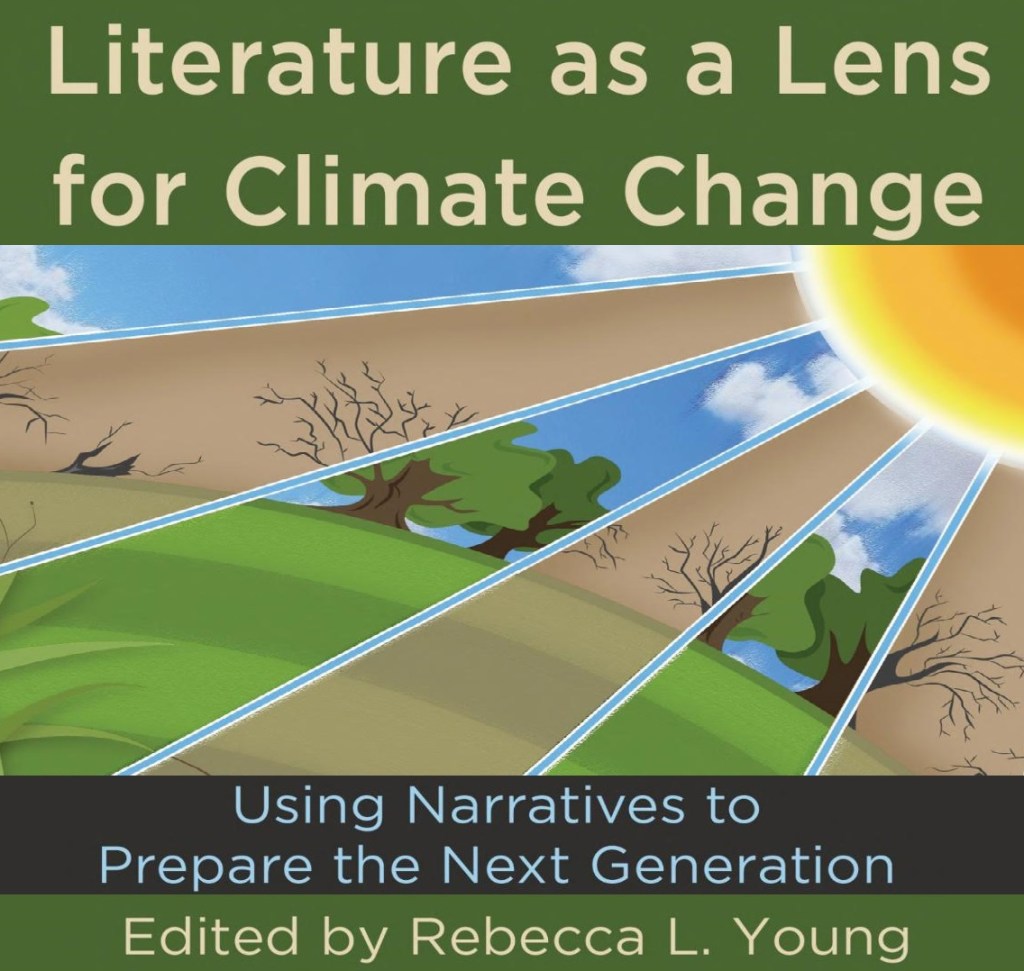
    My contribution to Literature as a lens for climate change (in 5 parts)
    Young, R. L. (2022). Literature as a lens for climate change : using narratives to prepare the next generation. Lexington Books.

    Listen here or Subscribe to Developmental Bibliotherapy Podcasts on Spotify

    Part 1 Introduction: Teaching Climate Change without Creating Despair or Entrenching Denial
    Part 2 Activism: Where Hope Rules
    Part 3 Harnessing the Power of Stories
    Part 4 Reading and Well-Being
    Part 5 Developmental Bibliotherapy and CLi-Fi
    References

    Albrecht, Glenn. 2012. “The Age of Solastalgia.” The Conversation. August 7, 2012. https://theconversation.com/the-age-of-solastalgia-8337.

    American Library Association. 2017. “Professional Ethics.” Tools, Publications & Resources. May 19, 2017. http://www.ala.org/tools/ethics.

    Andersen, Gregers, and Carsten Munk Hansen. 2014. “Fiction Prepares Us for a World Changed by Global Warming.” Humanities.ku.dk. University of Copenhagen. November 10, 2014. https://humanities.ku.dk/news/2014/fiction_prepares_us_for_a_world_changed_by_global_warming/.

    Bandura, Albert. 1978. “Self-Efficacy: Toward a Unifying Theory of Behavioral Change.” Advances in Behaviour Research and Therapy 1 (4): 139–61. https://doi.org/10.1016/0146-6402(78)90002-4.

    Cohen, Stanley. 2015. States of Denial : Knowing about Atrocities and Suffering. Cambridge, Uk: Polity ; Malden, Ma.

    Duggan, Joe. n.d. “This Is How Scientists Feel.” Is This How You Feel? Accessed June 25, 2021. https://www.isthishowyoufeel.com/this-is-how-scientists-feel.html.

    Eckersley, Richard. 2008. “‘Nihilism, Fundamentalism, or Activism: Three Responses to Fears of the Apocalypse’ by Eckersley, Richard – the Futurist, Vol. 42, Issue 1, January-February 2008 | Online Research Library: Questia.” The Futurist 42 (1). https://www.richardeckersley.com.au/attachments/Futurist_Apocalypse_2008.pdf.

    Edwards, Sarah Anne. 2008. “Eco-Anxiety: An Intelligent Response.” Eco-Anxiety. March 20, 2008. http://eco-anxiety.blogspot.com/2008/03/by-sarah-anne-edwards-phd-lcsw-articles.html.

    Gold, Joseph. 2001. Read for Your Life : Literature as a Life Support System. Markham, Ont.: Fitzhenry And Whiteside.

    Kelly, Claire M, Johanna M Mithen, Julie A Fischer, Betty A Kitchener, Anthony F Jorm, Adrian Lowe, and Chris Scanlan. 2011. “Youth Mental Health First Aid: A Description of the Program and an Initial Evaluation.” International Journal of Mental Health Systems 5 (1): 4. https://doi.org/10.1186/1752-4458-5-4.

    Konrath, S. H., E. H. O’Brien, and C. Hsing. 2010. “Changes in Dispositional Empathy in American College Students over Time: A Meta-Analysis.” Personality and Social Psychology Review 15 (2): 180–98. https://doi.org/10.1177/1088868310377395.

    Kringelbach, Morten L., and Kent C. Berridge. 2009. “Towards a Functional Neuroanatomy of Pleasure and Happiness.” Trends in Cognitive Sciences 13 (11): 479–87. https://doi.org/10.1016/j.tics.2009.08.006.

    Lilleslåtten, Mari , and University of Oslo. 2020. “Climate Change Impacts Nordic Literature – Department of Linguistics and Scandinavian Studies.” Www.hf.uio.no. March 5, 2020. https://www.hf.uio.no/iln/english/research/news-and-events/news/2020/climate-change-impacts-nordic-literature.html.

    Lopes, Lunna, Cailey Muñana, and 2019. 2019. “The Kaiser Family Foundation/Washington Post Climate Change Survey – Main Findings – 9349.” KFF. September 16, 2019. https://www.kff.org/report-section/the-kaiser-family-foundation-washington-post-climate-change-survey-main-findings/.

    Macmillan, Jade. 2021. “Deputy Prime Minister Flags Excluding Agriculture from 2050 Climate Target.” Www.abc.net.au. ABC. February 7, 2021. https://www.abc.net.au/news/2021-02-07/michael-mccormack-flags-excluding-agriculture-climate-target/13130160.

    Marsden, John. 2019. The Art of Growing Up. Sydney, N.S.W.: Pan Macmillan Australia.

    Merzian, Richie, Audrey Quicke, Ebony Bennett, Rod Campbell, and Tom Swann. 2019. “Climate of the Nation 2019 Tracking Australia’s Attitudes towards Climate Change and Energy.” https://australiainstitute.org.au/wp-content/uploads/2020/12/Climate-of-the-Nation-2019-WEB.pdf.

    Mission Australia , and Black Dog Institute. 2017. “Youth Mental Health Report : Youth Survey 2012-16.” Sydney, N.S.W.: Mission Australia. https://blackdoginstitute.org.au/docs/default-source/research/evidence-and-policy-section/2017-youth-mental-health-report_mission-australia-and-black-dog-institute.pdf?sfvrsn=6.

    Morehead, James. 2016. “Stanford University’s Carol Dweck on the Growth Mindset and Education.” OneDublin.org. OneDublin.org. April 18, 2016. https://onedublin.org/2012/06/19/stanford-universitys-carol-dweck-on-the-growth-mindset-and-education/.

    Noe, Alva. 2019. “NPR Choice Page.” Npr.org. 2019. https://www.npr.org/sections/13.7/2016/06/17/481977405/why-do-our-minds-wander.

    O’Brien, Karen, Elin Selboe, and Bronwyn M. Hayward. 2018. “Exploring Youth Activism on Climate Change:  Dutiful, Disruptive, and Dangerous Dissent.” Ecology and Society 23 (3). https://doi.org/10.5751/es-10287-230342.

    Oades, Lindsay G., Aaron Jarden, Hanchao Hou, Corina Ozturk, Paige Williams, Gavin R. Slemp, and Lanxi Huang. 2021. “Wellbeing Literacy: A Capability Model for Wellbeing Science and Practice.” International Journal of Environmental Research and Public Health 18 (2): 719. https://doi.org/10.3390/ijerph18020719.

    Olsen, Marci. 2006. “Bibliotherapy: School Psychologists’ Report of Use and Efficacy BYU ScholarsArchive Citation.” Scholars Archive. https://scholarsarchive.byu.edu/cgi/viewcontent.cgi?article=1408&context=etd.

    Ortiz, Diego Arguedas. 2019. “How Science Fiction Helps Readers Understand Climate Change.” Www.bbc.com. BBC. January 15, 2019. https://www.bbc.com/culture/article/20190110-how-science-fiction-helps-readers-understand-climate-change.

    Pew Research Center. 2019. “Most U.S. Teens See Anxiety and Depression as a Major Problem among Their Peers.” PEW Research Center. https://www.pewresearch.org/social-trends/wp-content/uploads/sites/3/2019/02/Pew-Research-Center_Teens-report_full-2.pdf.

    Richards Bodart, Joni, Ashley N. Barrineau, and Mary L. Flamino. 2011. “The Printz Award Winners under a Microscope: Content Trends, Committee Challenges, and Teen Popularity.” The Journal of Research on Libraries and Young Adults. Young Adult Library Services Association. http://www.yalsa.ala.org/jrlya/2011/02/the-printz-award-winners-under-a-microscope-content-trends-committee-challenges-and-teen-popularity/.

    Rubin, Rhea J. 1979. “Uses of Bibliotherapy in Response to the 1970s.” Library Trends 28 (2): 239–52. https://eric.ed.gov/?id=EJ212852.

    Stajkovic, Alexander D. 2006. “Development of a Core Confidence-Higher Order Construct.” Journal of Applied Psychology 91 (6): 1208–24. https://doi.org/10.1037/0021-9010.91.6.1208.

    Stark, Eloise A., Peter Vuust, and Morten L. Kringelbach. 2018. “Chapter 7 – Music, Dance, and Other Art Forms: New Insights into the Links between Hedonia (Pleasure) and Eudaimonia (Well-Being).” Edited by Julia F. Christensen and Antoni Gomila. ScienceDirect. Elsevier. January 1, 2018. https://www.sciencedirect.com/science/article/pii/S0079612318300190.

    The Australian Psychological Society Limited. 2019. “Young People’s Voices in the Climate Crisis.” https://psychweek.org.au/2019-archive/.

    UNICEF. 2016. “Environment and Climate Change.” Unicef.org. 2016. https://www.unicef.org/environment-and-climate-change.

    Verlie, Blanche. 2019. “Bearing Worlds: Learning to Live-with Climate Change.” Environmental Education Research 25 (5): 751–66. https://doi.org/10.1080/13504622.2019.1637823.

    Wakeman, Judith. 2019. “Activities & Printables.” Developmental Bibliotherapy. November 18, 2019. https://read4life.today/activities/.

    Wiessner, Polly W. 2014. “Embers of Society: Firelight Talk among the Ju/’Hoansi Bushmen.” Proceedings of the National Academy of Sciences 111 (39): 14027–35. https://doi.org/10.1073/pnas.1404212111.

  • Literacy Links to Wellbeing

    Literacy Links to Wellbeing

    Reading Fiction can Influence Wellbeing Literacy.

    A team at Melbourne University is proposing a Capability Model for Wellbeing Literacy. This model attributes an agency, intention and freedom of choice (a capability) to enhance and maintain the wellbeing of ourselves, others and the wider world, made possible by way of multimodal forms of language. The team’s 2021 paper entitled “Wellbeing Literacy: A Capability Model for Wellbeing Science and Practice” (Oades et al. 2021) adds further weight to the assertion that reading enhances wellbeing.

    The Melbourne University team defines wellbeing literacy as the “capability to comprehend and compose wellbeing language, (across contexts) with the intention of using such language to maintain or improve the wellbeing of oneself, others or the world”.

    The article refers to language as a “resource that people use actively to construct their psychological and social realities”. Wellbeing literacy relies on being able to recognise and interpret the language of wellbeing. But as our capacity to use language expands, so does our capacity to recognise, interpret and articulate our wellbeing insights and experiences. Not only do we become agents in our own wellbeing, but we are able to make conscious choices that influence our own wellbeing and that of others, and we recognise that our state of wellbeing is a personal choice and we have the freedom to make those choices.

    According to the Capability Model, language provides people with the capability to convert wellbeing opportunities into wellbeing experiences and achievements. This article also recognises that with more language opportunities comes more choices, greater freedom of choice and a broader interpretation of concept of wellbeing. Language can also reframe experiences to enhance wellbeing – an aspect of the written word as well known to poets as it is to journalists.

    It is easy to see how reading supports this model: as protagonists use language to support their own wellbeing and demonstrate agency in their own choices we might start to recognise and realise our own values, agency and potential. Through the narrative we are able to find insights into our wellbeing experiences and achievements.

    In the Capability Model wellbeing literacy becomes a recognisable aspect of Developmental Bibliotherapy, both dynamic and very personal, and closely connected to agency and the “freedom to choose what wellbeing means to a person and [the] choice in how that is maximised via language and knowledge.”

    Ultimately, maintaining our wellbeing is a personal endeavour, related to our goals, values, relationships and past experiences. However, as language expands our capability of experiencing wellbeing, fiction provides language in context and offers a myriad of opportunities to learn the language of wellbeing and the freedom to discover, trial and explore our own unique versions of wellbeing.

    Bibliography
    Oades, Lindsay G., Aaron Jarden, Hanchao Hou, Corina Ozturk, Paige Williams, Gavin R. Slemp, and Lanxi Huang. 2021. “Wellbeing Literacy: A Capability Model for Wellbeing Science and Practice.” International Journal of Environmental Research and Public Health 18 (2): 719. https://doi.org/10.3390/ijerph18020719.

  • Reading and the Default Mode Network

    Reading and the Default Mode Network

    We read books to find out who we are.”
    — Ursula Le Guin in The Language of the Night, 1979.

    Image by John Hain from Pixabay

    What is the Default Mode Network?

    The Default Mode Network (DMN) is that part of the brain most active during REM sleep, while daydreaming and while reading stories.

    The DMN is associated with task-unrelated thinking, sometimes called Spontaneous or Stimulus-Independent thought, and has been described as “The brain running in neutral” activated “precisely when we detach ourselves from what’s going on around us” (Noë, 2017).

    “Spontaneous thought allows individuals to construct and simulate alternative scenarios, mentally-organize their plans, and prepare for what may lie ahead … and facilitate the organization and structuring of daily events.” (Andrews-Hanna, 2011 )

    The Sentinel

    But, while the DMN can be thought of as the parts of the brain that are not engaged with processing sensory information or attending to external stimuli (one reason why the study of DMN is difficult), research also supports a “sentinel hypothesis” in which the DMN concurrently monitors the external environment for upcoming stimuli or other significant, unpredictable events; precisely the situation in which we respond to an unexpected event “without thinking” – far from being in a “world of our own” our DMN has been monitoring our external world and is already engaged sufficiently with our memories to react instantaneously.

    Eudaimonia, Wellbeing and Pleasure

    The findings that the DMN is activated when we are directing our attention inwards may be the reason that the DMN has been linked with the development of Eudaimonia, described by Aristotle as ‘doing and living well’. Vessel (2019) also linked the DMN to the perception of beauty related to aesthetics, including an inner feeling of pleasure associated with music, artworks, landscapes and architecture, perhaps because these activities are often linked with pleasant memories. It is not surprising then to learn that many of the key regions of the pleasure system are part of the Default Mode Network.

    Defining Ourselves

    The DMN is in a constant performance/feedback/revision loop as it continually stores, reviews and applies learned information, consolidating our recent experiences, and enabling us to make sense of the chaotic and disconnected events that we encounter daily.

    Our DMN is active whenever we are thinking about ourselves or others, when we are remembering the past or using our past experiences to plan for the future, when we are interacting in social contexts and finding our place in the world, and when we are using our self knowledge to make choices, explore our creativity and test our boundaries.

    DMN is Responsible for:

    All the processes that make us who we are as individuals and as members of the society we inhabit…

    FORMING Personal Narratives and Autobiographical Memories –

    Understanding and accepting our emotional responses, and assimilating facts and events about ourselves into our understanding and knowledge of our personal traits, and our strengths and weaknesses.

    DEVELOPING Theory of Mind –

    Understanding diversity in viewpoints and opinions, developing Empathy and Moral Reasoning, learning to interpret Social cues and examine Stereotypes, and then learning to modify our behaviour to suit different social situations 

    Managing Memories –

    Creating memories and then enabling us to recall and apply these memories, access intrinsic understanding, imagine possible futures, comprehend narratives, and respond without thinking in unexpected situations.  

    APPLYING Insight & Intuition –

    Responsible for the Aha moments, lateral thinking, creativity and confidence in problem solving, Spontaneous Thought and automatic responses that protect us in Sentinel mode, and

    DEVELOPING a Growth Mindset through Vicarious Learning –

    Building efficacy, hope, optimism, emotional resilience and curiosity, interpreting simulations & making predictions, finding pathways, overcoming obstacles, through the actions of others

    HELPING to Making Sense of the World –

    Assimilating and interpreting narratives, creating order from chaos, identifying patterns and logical thought processes, analysing and synthesising the day’s events.

    Stories and the Default Mode Network

    When we read, our DMN is helping us imagine journeys with heroes and villians, define our values and our goals, helping us visualize different perspectives and pathways, supporting our capacity to simulate hypothetical scenes, spaces and mental states; we must access our memories in order to understand the story we’re reading and visualise the scenes within the novel. Our DMN is active when we respond to the word ‘Dog’, associating that one word with the memories and emotions linked to a multitude of interactions with dogs, all invoked by the present instance of a dog within the pages of a novel.

    It is the correlation between Reading Fiction and the activation of the Default Mode Network, with its positive links to eudaimonic states and wellbeing, aesthetics, social responsibility, and the self awareness that necessitates the welfare of the self in future endeavours, that presents the most compelling case for Developmental Bibliotherapy in schools.

    References

    Andrews-Hanna, J. R. (2011). The Brain’s Default Network and Its Adaptive Role in Internal Mentation. The Neuroscientist18(3), 251–270. https://doi.org/10.1177/1073858411403316

    Noë, A. (2016, June 17). Why Do Our Minds Wander? Npr.Org; NPR. https://www.npr.org/sections/13.7/2016/06/17/481977405/why-do-our-minds-wander

    Stark, E. A., Vuust, P., & Kringelbach, M. L. (2018, January 1). Chapter 7 – Music, dance, and other art forms: New insights into the links between hedonia (pleasure) and eudaimonia (well-being) (J. F. Christensen & A. Gomila (eds.)). ScienceDirect; Elsevier. https://www.sciencedirect.com/science/article/pii/S0079612318300190

    Vessel, E. A., Isik, A. I., Belfi, A. M., Stahl, J. L., & Starr, G. G. (2019). The default-mode network represents aesthetic appeal that generalizes across visual domains. Proceedings of the National Academy of Sciences116(38), 19155–19164. https://doi.org/10.1073/pnas.1902650116

    Wikipedia Contributors. (2019, May 15). Default mode network. Wikipedia; Wikimedia Foundation. https://en.wikipedia.org/wiki/Default_mode_network

  • Confronting the Difficult Topics in YA Fiction

    Confronting the Difficult Topics in YA Fiction

    There is no magic cure, no making it all go away forever. There are only small steps upward; an easier day, an unexpected laugh, a mirror that doesn’t matter anymore.

    Laurie Halse Anderson

    Eating disorders and Self Harm

    YA Authors take their responsibility very seriously when writing about Eating Disorders and Self Harm. There is an unpredictability that surrounds the triggers for both of these issues and for that reason, the YA fiction on this topic may be a useful way to give parents some understanding, however slight, of their child’s thoughts.

    Laurie Halse Anderson, submitted the manuscript of Wintergirls,  to experts on the subject of eating disorders before publication. Her challenge was to ensure that Wintergirls told the whole story.

    Elena Vanishing: a Memoir by Elena Dunkle describes how difficult it was for the author to accept her problem and ask for help – an echo of her personal battle with an eating disorder.

    Girl in pieces by Kathleen Glasgow begins with the protagonist in a treatment facility after a serious episode self-harm. The complex thoughts behind the decisions to self-harm are insights generously shared by the author from her own personal experiences.

    These books may act as a conversation starter that creates understanding, and can also provide insights for people caring for young adults experiencing these disorders.

    Note: It is important that school librarians are aware of the books dealing with eating disorders and self-harm in their libraries, and aware when students are reading them.

    Suicide

    No one knows for certain how much impact they have on the lives of other people. Oftentimes, we have no clue.
    Yet we push it just the same.

    Jay Asher

    Jay Asher’s 13 reasons why is not the first YA novel to address suicide, but when it became a televised miniseries it attracted the concerns of parents afraid that talking or reading about suicide may prompt young people to take the same course of action. Evidence says that the opposite is more likely to be the case – a discussion of suicide does not initiate thoughts of suicide if they are not already present, but enabling someone to discuss suicidal thoughts, whether with friends or family, is more likely to prevent them from putting those thoughts into action.

    At the core of 13 reasons why is the death by suicide of a teenage girl. The novel addresses teen suicide, mental illness, reputation-worship, gossip and slander, nearsighted impulsivity, sexual abuse, and malignant narcissism. These issues resonated with teens and had a significant impact on those who read the story. The novel neither glamorised nor preached, instead leaving it up to the reader to draw their own conclusions.

    Teens commented that this book made them realise how their actions could have unforeseen consequences, how seemingly small things can be compounded to produce a significant but unforeseen effect, and how we never fully realise what is going on behind the scenes for a person who we think we know quite well.

    And, because the main character was guilty of inaction, it also contained a plea to those who might otherwise remain bystanders.

    Last word …

    Early intervention has been shown to minimise the disruption caused by mental health at all ages. YA Fiction enables early intervention by providing language, by reducing stigmas and stereotypes, by both posing and answering questions, and by facilitating conversations.

  • Stories Help Young People Navigate Adolescence

    Stories Help Young People Navigate Adolescence

    Young People need School Libraries

    Students need school librarians and dedicated reading programs to enhance their mental health and wellbeing.

    Not only does reading fiction help adolescents navigate personal and emotional development during their teens, but developing a reading habit can help to mitigate the disruptive effects of mental health throughout their entire lives.

    What’s special about stories?

    Stories show us that it’s okay to fail, that mistakes are opportunities for learning, that courage isn’t an absence of fear, and that not everyone is as they seem.

    Stories help us identify and refine our values and ideals, show us what resilience looks like, help us to define our goals and encourage us to explore our emotions.

    Stories reflect and validate our lived experiences, help us to accept our past, help us to create order from our chaotic lives, and encourage us to be optimistic about the future.

    Stories comfort us, help us connect with others and make us feel less alone.

    Stories reframe our problems, help us create distance and see different perspectives, and nurture optimism, hope and self-efficacy.

    Stories promote empathy and compassion, remove stigmas and stereotypes, help us to embrace diversity and show us a wider view of normal.

    Stories introduce us to ancient wisdom and create intergenerational connections.

    Stories help us to understand our world, help us to recognize the importance of our own life story as part of a bigger picture and help us to be more accepting of ourselves.

    Stories give us answers to questions we don’t know how to ask.

    Stories stimulate our imagination.

    Stories give us role models to inspire us to persevere and improve, to empower us to speak out, to join in celebrating the successes of others, and to help us to be grateful and accepting of ourselves.

    Stories give us the insight, the language and the confidence to seek help when we need to share our concerns or can’t manage alone.

    Stories are not only the easiest way but sometimes the only way to learn about ourselves, and find our place in the society and the world we inhabit, from a safe and secure place.

    Who can ensure our students are learning these things if not the teacher librarian?

    Why is a Teacher Librarian is the best person to implement
    Developmental Bibliotherapy?

    Teacher Librarians love to talk about books and
    Teacher Librarians provide guidance, encouragement opportunities for learning without grades.

    NOTE: Books do not judge and neither should librarians – remember that in developmental Bibliotherapy activities there are no wrong answers.

    Developmental Bibliotherapy occurs when
    Young People recognize that a change has taken place

    in their Thoughts, Feelings, Actions or Beliefs.

    Implementing Developmental Bibliotherapy is about asking the right questions to help this self reflection to take place. It can take as little as fa few minutes as an informal chat, or it can be developed into a unit of work.

    Whether as an informal chat, recalling an event or quote from a novel, creating a piece of artwork or writing a book review, Developmental Bibliotherapy is almost certainly taking place in every library wherever a skillful teacher librarian is talking to young people about the books they are reading.

    Go to the Activities and Printables page for ideas on Implementing Developmental Bibliotherapy or ways you can ensure that your existing programs are creating the conditions for change.

    If an activity results in the reader reflecting and articulating a positive change
    in their
    Thoughts, Feelings, Actions or Beliefs
    then Developmental Bibliotherapy has been in action.

    Although reading fiction is not a panacea, by showing young people a wider view of normal, by allowing them to explore their emotions and their identity alongside fictional heroes, by removing stigmas and stereotypes and by giving them the language and the confidence to seek answers from trusted adults, Developmental Bibliotherapy programs gives students skills that can promote better mental health outcomes throughout their lives.

  • Cultivating Core Confidence

    Cultivating Core Confidence

    When children read about ordinary people achieving extraordinary successes, they come to realize that the brain is flexible and adaptable, and that intelligence, like confidence, can be also be developed – they adopt a “growth mindset”

    How can we immunize young people against the disruptive force of mental illness? Joseph Gold (2001)

    By ignoring the potential of books in the development of Core Confidence in young people we are depriving them of the opportunity to develop this most vital aspect of their being.

    Alexander Stajkovic’s theory of Core Confidence says that Confidence resides unseen in the core of an individual’s character, and is manifested in Hope, Self-efficacy, Resilience and Optimism. These distinct but interconnected elements can predict job satisfaction, job performance and, ultimately, satisfaction with life. Furthermore, Stajkovic believed that these elements can be cultivated in all of us.

    I believe they can be cultivated in young people using Developmental Bibliotherapy.

    Cultivating Core Confidence with Books

    Self-efficacy

    “The moment you doubt whether you can fly, you cease for ever to be able to do it.”

    Peter Pan in J.M. Barrie’s book of the same name.

    Self-efficacy refers to the belief in one’s ability to produce a given level of attainment. It is disctinct from but related to self-esteem, motivation and resilience.

    Self-efficacy influences the goals that we choose for ourselves, the confidence in our ability to learn new tasks and especially, whether we believe that abilities can be learned and developed or are fixed.

    Unsurprisingly, mastery of a skill is the most powerful way to build self-efficacy. Through mastery we see that skills can be acquired and as our self-efficacy increases we are encouraged to attempt still more new skills. But influential people in our lives can also strengthen our self-efficacy – with meaningful feedback, encouragement and support we are motivated to greater efforts.

    The second most powerful way to cultivate self-efficacy is through Vicarious Learning – watching or reading about people, especially role models, succeeding by their sustained effort raises our beliefs in our own abilities, much the same way that an outstanding team member can raise the achievements of less talented players in a team.

    Whether we are reading horror and suspense, romance or an autobiography, mirror neurons respond to the emotions and triumphs of characters as if they were our own. And as our brains are flooded with the thoughts and experiences of characters within the pages of a book our brain is leaning vicariously – imagining conversations, testing alternatives and refining our beliefs.

    Hope

    “Hope can be a powerful force. Maybe there’s no actual magic in it, but when you know what you hope for most and hold it like a light within you, you can make things happen, almost like magic.”

    Laini Taylor in Daughter of Smoke & Bone

    Hope has the power to heal afflictions and helps us endure times of great suffering. Hope has a very positive impact on health, academic achievement, athletic accomplishment, emotional health, personal meaning and our ability to cope with adversity.

    Hope has a positive impact on health, academic achievement, athletic accomplishment, emotional health, personal meaning and our ability to cope with adversity. Hopeful thinking is both a trait and a positive motivational state. We think of Hope as being made up of Pathways towards achieving a goal and the determination to achieve a certain goal known as Agency).

    We cultivate Hope by visualising multiple pathways towards our goal, by maintaining our motivation towards achieving that goal and by believing in our power to achieve our goal.

    “No matter what sort of difficulties, how painful experience is, if we lose our hope, that’s our real disaster.” 

    Dalai Lama XIV

    But to cultivate Hope we must first identify our dreams; and our dreams emerge once we recognize those things we value in ourselves, our relationships and our environment.

    Literature helps us to identify our values and decide what is important to us by guiding us through self-reflection. As we share the hopes and disappointments of fictional characters facing obstacles in their fictional quest, we learn to be flexible and adaptable, we visualize alternative strategies towards our own quests, we learn that setbacks and detours are obstacles to be overcome; and we begin to imagine our own paths and dreams.

    “The idea of a happy ending is a very powerful thing. Living in a world without hope would be very bleak indeed”. 

    Josh Dallas (Once Upon a Time)

    We accompany characters as they make mistakes and choices, forge relationships and face dangers and we learn to predict, to envisage alternative actions and to consider “what if” outcomes. As we follow, and sometimes identify with, the fictional character on their quest, we learn to forgive their mistakes and transgressions, and we develop empathy and compassion.

    Optimism

    “What day is it?” asked Pooh.
    “It’s today,” squeaked Piglet.
    “My favorite day,” said Pooh.”

    A.A. Milne in Winnie the Pooh

    Optimism is the belief that we are responsible for our own happiness and that more good things will happen to us in the future. For optimism to be a positive force this belief must be realistic – appreciating the positive aspects of a situation without ignoring the negative – and our belief must allow for the possibility that bad things do happen to good people.

    Optimism can affect our personal growth, our sense of purpose in work, our relations with others, our pride in our accomplishments, and our general level of happiness and life satisfaction. Optimistic students are less susceptible to stress, loneliness and depression, and less likely to drop out. Optimists are also more likely to have healthy lifestyles.

    Literature helps to cultivate our optimism by helping us escape the limitations of our environment and negativity from our influencers. Literature stimulates our imagination and enables us to organise our own experiences while in the process of deciphering someone else’s. Literature helps us to make sense of the past and become less fearful of an uncertain and sometimes terrifying future.

    Resilience

    “It came to me that I hadn’t known that I was less than I could have been until then, when I saw there was so much more of the world for me to be myself within.”

    Griz in “A Boy and His Dog at the End of the World” by C. A. Fletcher

    Resilience is the ability to take responsibility for creating the future we want, to persevere through everyday adversities and tribulations, to adapt or overcome major setbacks, and to reach out to new experiences and challenges.

    Resilience transforms hardship into challenge, failure into success, helplessness into power, victims into survivors and allows survivors to thrive.

    Resilience comes when we believe that we have the power to control the events in our life and to change the things that need changing, and that belief is accurate. Resilience is not a trait that one either has or does not have; resilience is a state that involves behaviours, thoughts and actions, and it can be learned and developed.

    • Resilient individuals seek connections, they accept help and they try to help others.
    • Resilient individuals accept change as a path to growth.
    • Resilient individuals can recognise and articulate feelings, needs and viewpoints and are open to the opinions of others.
    • Resilient people stay curious about their world, and about the past and the future, and they are reflective and mindful of their own and others’ thoughts and emotions.
    • Resilient people maintain a positive self-image, a sense of perspective and derive meaning from failure.
    • Resilient people are see obstacles as ambitious but attainable tasks.
    • Resilient people enjoy learning new skills and use creative experiences to bolster their wellbeing.

    Fictional characters can inspire us to develop our own resilience by watching them develop through the choices and responses they make. We learn that resilience is something that we cultivate, not something we are born with, and that sometimes resilience requires immediate action, but most often it does not. We see that resilience involves a realistic evaluation of a situation, to consider for alternative solutions, to be less reactive to our emotions, and to respond better when adversity strikes.


    The Danger of Excess

    It is possible to have too much of these elements of Core Confidence:

    • Too much Self efficacy can make us over confident and we neglect our training, we believe we have nothing left to learn, or we reject new ideas and suggestions.
    • Too much Hope can anesthetise us, keeping us passive when we should be motivated into action.
    • Too much Optimism can shroud us in illusions and irrational beliefs, or cause us to waste energy on unattainable goals.
    • Too much Resilience can make us overly tolerant of adversity, or make us resigned and apathetic in the face of danger.

    Hope, Resilience, Self-efficacy and Optimism are states that amalgamate to form Core Confidence, so interdependent that when one is out of balance, the others will fail alongside it or fall behind and either way our Core Confidence is diminished. So it is far better to have too much Core Confidence than too little.

    Developmental Bibliotherapy and Core Confidence

    Joseph Gold (1998) describes the beneficial power of fiction thus:
    “Fiction extracts the reader from their immersion in personal confusion … using narrative to engage the reader emotionally while generating new and newly arranged information so that cognitive shift can take place. The results of this are improved problem solving skills, a greater sense of normality, a breakup of rigid and confusing cognitive frameworks, improved socialization and increased self-actualization.”

    Developmental Bibliotherapy has the advantages over other all programs in that it can be infinitely tailored to meet the needs of almost any student. It can be practiced anywhere at any time, alone or in a group, at any age.  

    And the resources necessary to implement Developmental Bibliotherapy are already abundant in most schools.

    By ignoring the potential of books in the development of Core Confidence in young people we are depriving them of the opportunity to develop this most vital aspect of their education.

    “I was seeing the world through the lens of the books I had read about it”

    Griz in “A Boy and His Dog at the End of the World” by C. A. Fletcher

    Further Reading & References

    ‌Get Printable Version Cultivating Core Confidence

  • An Ounce of Prevention

    An Ounce of Prevention

    If we could design a program for young adults with the aim of boosting good mental health, like a wellbeing vitamin, what would such a program look like?

    Which personal qualities enable some young people to ride the rollercoaster that is adolescence and emerge confident that they can forge their own path within the society they are set to inhabit?

    And how we can provide children and young adults with the education that enhances their own particular strengths?

    Attributes and Character Strengths for the 21st Century.

    Twenty first century teens face enormous educational, social and global pressures reflected by escalating numbers of young people with mental health issues.

    Alexander Stajkovic proposed that Core Confidence, made up of Self efficacy, Resilience, Optimism and Hope, form an inner resource which helps us avoid being crushed by the setbacks we face during our lives.

    Martin Seligman suggested that we are better placed to overcome challenging situations if we can eliminate Personalisation, Permanence and Pervasiveness from our set of personal beliefs. Seligman also revisited the term “Positive Psychology”, and identified 24 Signature Strengths, in five broad groups, that we can use or develop to achieve our potential for wellbeing, happiness and fulfilment (including seven key attributes – Self Control, Zest, Social Intelligence, Gratitude, Optimism, Curiosity and Grit, “a perseverance and passion for long-term goals” – can predict academic success).

    At Camp Kulin, Western Australia, life skills such leadership, respect, trust, self confidence, self respect, self esteem, emotional regulation, anger management and perseverance are shown to improve personal, behavioural and academic outcomes for their adolescent participants.

    And, John Marsden, Australian author and school principal, in saying that “by limiting children’s exposure to danger, to fear, we are limiting their ability to mature, develop resilience and independence”, reinforces recent findings that children need to experience failure and risk.

    How do we kindle these qualities in young people; how do we nurture them into self sustaining personal attributes?

    Research tells us that we can do this by simply encouraging children to read!

    What’s Special About Books?

    When a child first becomes an independent reader, they proudly, confidently and independently begin to explore new worlds. Inside the covers of books they meet new characters, confront questions and find answers, develop creativity and imagination; and they no longer rely on others for entertainment. They are separating from their parents while simultaneously taking steps towards becoming members of the grown-up world; able to communicate and share stories beyond their own limited experiences. 

    As children read they learn that they can experience things as individuals, they become confident communicators, they become creative problem solvers, and they start to understand, recognise and relate to emotions. Their brain is learning vicariously, and these new skills, characteristics and attributes accompany developments in cognitive skills (thinking, problem solving, reasoning, remembering and concentration).

    As they read they begin to develop a Theory of Mind – able to consider others’ perspectives and needs – and so they start to develop empathy and start caring for others. They learn about diversity as they read stories about how other people (or animals, or imaginary creatures like fairies, or inanimate objects like pencils) go about their lives, expressingr emotions and coping with different problems and situations.

    But they also learn that others experience similar feelings to themselves, such as nervousness, fearfulness or anger, and they begin to explore these feelings from a safe place within the pages of a book. They learn that sometimes bad things happen, sometimes good people fail and sometimes life isn’t fair, but that these times don’t last forever.

    Characters in these first stories can help children start to think about how they want to live their lives and their own place in the world, and they help readers to explore different opportunities and possibilities. Children are developing and reflecting on their own personal values, but they are also confronting fears, taking risks, accepting failure, forming friendships, breaking barriers, challenging stereotypes and exploring alternative worlds, safely within the worlds inside a book.

    Along the journey from childhood to adulthood, young adults must balance pressures from family, school, friends and often social and cultural expectations, with a personal need to explore their potential, develop and express their individual values and styles, and test their own boundaries as they reflect on what it means to live “the good life”. Many are terrified in the knowledge that their generation is facing an uncertain future with unforeseeable problems.  

    Young adult readers find role models among the authentic characters created by respected Young Adult authors, perhaps in addition to the adults in their lives or perhaps in the absence of trustworthy adults, to assist and guide them during their teen years.

    Bibliotherapy and the Default Mode Network.

    The Default Mode Network is a group of connected regions in the brain, which is most associated with task-unrelated thinking and has been described as “The brain running in neutral” activated “precisely when we detach ourselves from what’s going on around us” (Noë, 2017).

    The Default Mode Network is responsible for:

    • Autobiographical Memory – forming our personal memories and our understanding and reflection of ourselves, including our strengths and our emotions;
    • Social information – developing a Theory of Mind, empathy, moral reasoning, intuition, stereotyping, social skills;
    • Applying Memories – recalling the past, imagining the future, comprehending narratives;
    • Spontaneous Thought – contributing creativity in problem solving and AHA moments as well as enabling rapid automatic and instinctive reactions.

    The Default Mode Network is most active when daydreaming, during REM sleep and while reading. Disruption in Default Mode Network connectivity has been linked to mental health issues including depression, schizophrenia and Alzheimer’s.

    The Default Mode Network is responsible for continually storing and applying learned information, enabling us to make sense of the chaotic and disconnected events that we encounter daily. It is active whenever we are thinking about ourselves or others, when we are remembering the past or using our past experiences to plan for the future, when we are interacting in social contexts and finding our place in the world, and when we are exploring our creativity and testing our boundaries.

    Default Mode Network is activated when we read because it supports our capacity to simulate hypothetical scenes, spaces and mental states; we must access our memories in order to understand the story we’re reading.

    It is the function of the Default Mode Network (DMN), and its relationship to reading and mental health, that presents the most compelling case for more Developmental Bibliotherapy in schools.

    Conclusion

    It is important to acknowledge that there are many categories falling under the mental illness diagnosis, and within these categories there are different underlying causes. These causes can be classified as biological, psychological and social.

    Furthermore, the difficulty of separating developmental issues from abnormal problems that require medical intervention (or as Australian comedian Alice Fraser describes it “a disaster thing or a coming-of-age thing”), the difficulties in diagnosing young people in whom emotional issues present as physical problems and uncovering hidden problems in young people who may struggle with language or trust, add to the complexities in the diagnosis and treatment of childhood and adolescent mental health.

    However, all evidence indicates that early intervention is the key to minimising the impact of mental illness. Bibliotherapy increases the likelihood of early intervention by providing language and opening communication with trusted adults, by addressing Seligman’s “3Ps” by portraying characters in similar situations, by removing stigmas and shattering stereotypes, by increasing empathy and representing diversity, by reducing fear and isolation, and by representing a wider view of normal.

    Learning from the experiences of fictional or real characters enables all of us to stand on their shoulders and thus experience a wider view of ourselves, the world and our place in it, and forces us to ask what type of life and world do we want for ourselves.

    The evidence is clear – the most cost-effective way to provide mental health benefits to children and young adults begins with supporting school libraries, employing qualified library staff and timetabling meaningful library programs.

    References for this post can be found on the Online Resources & Further Reading page.


  • Teens Need books Now More Than Ever…

    Teens Need books Now More Than Ever…

    “Fairy tales do not tell children that dragons exist. Children already know that dragons exist. Fairy tales tell children that dragons can be killed.”
    G. K. Chesterton

    What is Developmental Bibliotherapy?

    Developmental Bibliotherapy is a branch of Bibliography which usually takes place as part of a secondary school reading program using young adult fiction and designed to help young people navigate the many issues they encounter during their adolescence.

    Inside contemporary Young Adult Fiction, authors create authentic characters and anticipate their readers’ questions and concerns. Teens gain insights from characters living in similar situations, validating readers’ experiences and introducing them to language and options that may not have been previously known to them.

    In this way, Young Adult Fiction becomes an effective way to break down the stigmas and stereotypes that are the major barrier preventing young people from seeking help for themselves or for others.

    The objective of Developmental Bibliotherapy is to change readers’ Thoughts, Feelings, Actions and Beliefs, especially related to mental health issues, enabling conversations and addressing fears, so that issues can be identified and addressed as early as possible.

    And yet, while Developmental Bibliotherapy is easily incorporated into most school reading programs, its potential for changing the lives of young people by building resilience and equipping them with skills in preparation for a crisis or a troublesome situation, has not been given sufficient attention in the fight to save school libraries and librarians.

    At a time when our children and young adults need their stories told more than ever, schools are ignoring the potential within the school libraries by trimming library budgets, abandoning library programs in favour of academic programs and moving teacher librarians into classrooms.

    Confronting ‘Difficult’ Topics in YA Fiction

    We need stories to experience what it’s like to survive the unsurvivable; to find light in the darkest night.

    Jeff Zetner

    During their teens, young adults refine their personal expectations, desires and values while simultaneously facing pressures and expectations from their peers, the adults around them, and the wider community.

    Adolescence may involve issues of gender and sexuality, physical or mental illness, different ability and disability, otherness, grief, guilt, family issues, mental illness, addiction, sexual assault, relationship issues, peer pressures and significant life decisions, in addition to preparing for the 21st century issues that will confront them as an adult.

    Young Adult fiction is becoming more edgy, reflecting readers’ desire for stories dealing with these ‘difficult’ and sometimes controversial topics. Young adults want to see characters who are empowered, informed and able to build fulfilling lives – developing coping strategies and participating in meaningful relationships even while accepting the setbacks confronting them.

    Authors of contemporary Young Adult fiction are aware of their responsibility to represent the concerns and experiences of their audience respectfully and realistically in a way that is accessible and authentic without being didactic. In turn, Young Adult readers trust authors to give them accurate and relevant information, and answers to questions they may not know how to ask, in storylines that mirror the difficult issues they see amongst their peers.

    Mental Health

    In 2019, 70% of US teens, identify anxiety and depression as their major concern, either for themselves or as a concern for their peers.[ii] Australian young adults are no different. On average, one in seven young Australians currently in secondary education will experience one of the common mental health illnesses in any given year.[iii] Others will experience mental health issues as a carer or see a family member experiencing mental health issues.

    On average, one in seven young Australians currently in secondary education will experience one of the common mental health illnesses in any given year. Others will experience mental health issues as a carer, friend or family member of someone experiencing mental health issues.

    We experience good mental health as being in control of our emotions, able to make well considered decisions and having positive interactions with people around us. We meet life’s challenges with confidence in our own abilities, or seek help when we need it. We might say that our resilience is high.

    When our mental health is poor, our resilience is low, and we become confused and fearful. Setbacks often escalate into more serious issues that significantly disrupt our daily activities and relationships. And although early intervention can minimise the amount of disruption caused by a mental illness and increase the rate of recovery, we are fearful and reluctant to seek help because of the common stereotypes and stigmas that surround mental illness.

    And, while most teens readily discuss most aspects of their lives on social media, few feel able to discuss mental health concerns on these platforms.

    Young people need access to an adult they can trust – non-judgemental, discreet and knowledgeable and available – to discuss their concerns. It has been said that one trusted adult can make a significant difference to an adolescent’s outcomes. Amongst their most trusted adults are teachers, librarians and the authors who speak through characters with whom they can identify.

    Characters in Young Adult literature, introducing language to describe their experiences, enable readers to articulate their own experiences and help them facilitate their own real life conversations. Characters’ actions and experiences answer readers’ questions, validate their experiences, identify symptoms, explore options and explain treatments in ways that reduce the fear, eliminate the stigmas and shatter the stereotypes that may be preventing young people from discussing the way they are feeling or from seeking help.

    Books … explain us to ourselves and to others, and make us feel less strange, less isolated and less alone.

    Alain de Botton

    Furthermore, as young people read about fictional characters experiencing a mental illness, they develop empathy, becoming more supportive of others with a mental illness, and feeling more able to seek help for friends or family members who may be unable to take the effective action needed to help themselves.

    Being supported and equipped with appropriate vocabulary gives young people the confidence to share troubling thoughts and feelings with others and do so sooner, which improves the chances of better outcomes.

    Developmental Bibliotherapy

    The Limitations

    Developmental Bibliotherapy implemented by teachers, parents, librarians and counsellors can be a preventative strategy for teens but should not be seen as a substitute for long-range therapeutic intervention by a psychologist or psychiatrist where necessary. Bibliotherapy is not a panacea but it can be an effective adjunct to other treatments.

    For Developmental Bibliotherapy to have meaningful benefits, it requires cooperation, reading ability and desire on the part of the reader, a positive relationship between the reader and the therapist, and a skilful matching of reader with quality YA literature.

    School based Developmental Bibliotherapy programs need to include guided discussions and planned activities if they are to maximize positive outcomes.

    The Benefits

    Humans are the story species – the only species able to communicate across time and space. Stories have helped us survive as a species; by increasing our ability to make decisions, solve problems and deal with stress and change, by allowing us to safely test out courses of action, by improving social communication, and by learning from others’ mistakes.

    Bibliotherapy, the use of stories for personal growth and emotional healing, predates the written word. It is thought that storytelling emerged when primitive peoples harnessed fire and extended their wakening hours beyond sunset. Stories soothed fears, answered questions, stored knowledge, related heroic exploits and guided our physical and spiritual journeys.

    Fiction validates our emotions and experiences, and fortifies our resilience. When we read fiction we learn vicariously. Fiction provides us with a safe place from which to explore our thoughts and feelings, and provides opportunities to rehearse our interactions with others.

    Fiction promotes empathy by introducing us to diverse communities and showing us a wider variety of normal. Reading fiction provides us with models, helping us to define our boundaries and our values, and find answers within ourselves. And, by seeing our experiences in written form, fiction gives us the language to express ourselves.

    Fiction helps us relieve stress and emotions in a controlled manner, gain insight into our own behaviour, see different perspectives and find alternative solutions. It allows us to see others experiencing similar problems so we feel less isolated and alone, and prepares us for some of the issues we may be anticipating with dread, encouraging us to face problems before they escalate.

    Developmental Bibliotherapy must be implemented more widely in schools. It is an effective technique for helping children with a variety of topics – the advantages are many and the disadvantages are few.

    If literature is a really important human resource, how can we accept a situation that tolerates the loss of this resource to millions of people?

    Joseph Gold

    References for this post can be found on the Online Resources & Further Reading page.‌