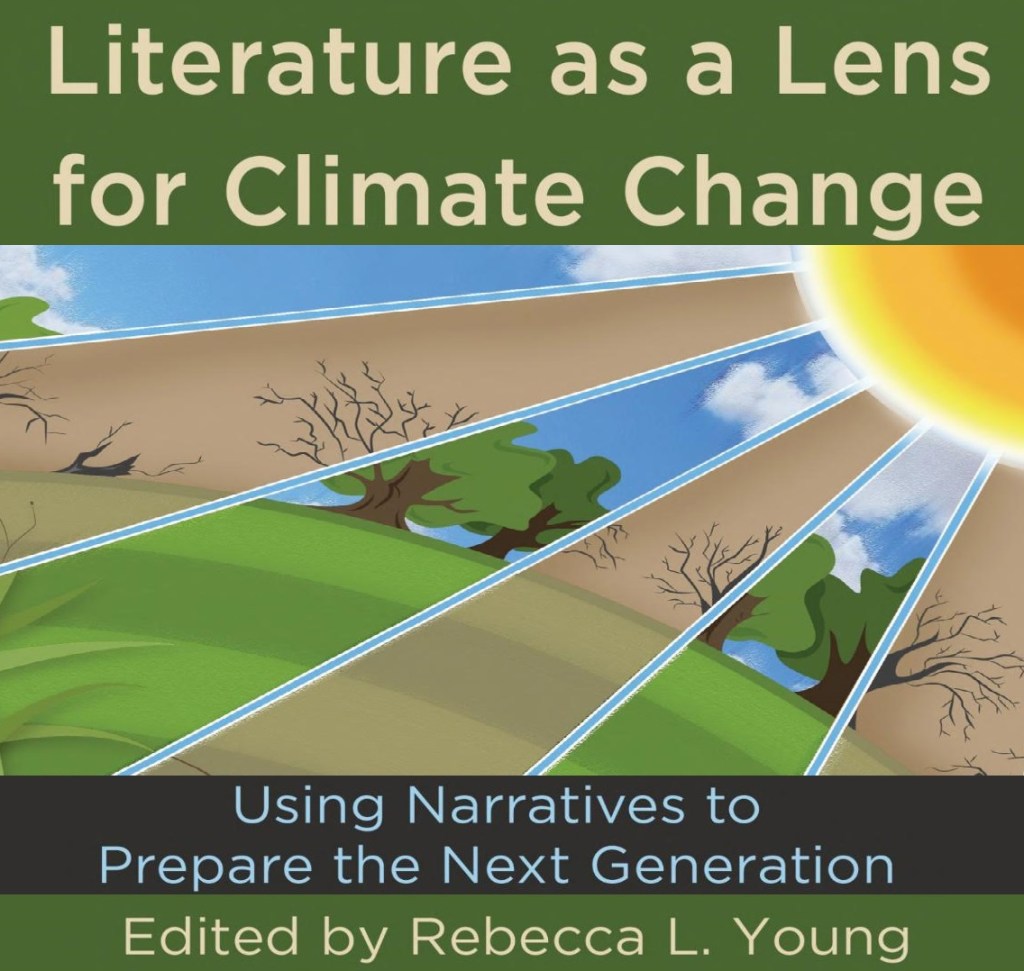
My contribution to Literature as a lens for climate change (in 5 parts) Young, R. L. (2022). Literature as a lens for climate change : using narratives to prepare the next generation. Lexington Books.
Bandura, Albert. 1978. “Self-Efficacy: Toward a Unifying Theory of Behavioral Change.” Advances in Behaviour Research and Therapy 1 (4): 139–61. https://doi.org/10.1016/0146-6402(78)90002-4.
Cohen, Stanley. 2015. States of Denial : Knowing about Atrocities and Suffering. Cambridge, Uk: Polity ; Malden, Ma.
Eckersley, Richard. 2008. “‘Nihilism, Fundamentalism, or Activism: Three Responses to Fears of the Apocalypse’ by Eckersley, Richard – the Futurist, Vol. 42, Issue 1, January-February 2008 | Online Research Library: Questia.” The Futurist 42 (1). https://www.richardeckersley.com.au/attachments/Futurist_Apocalypse_2008.pdf.
Gold, Joseph. 2001. Read for Your Life : Literature as a Life Support System. Markham, Ont.: Fitzhenry And Whiteside.
Kelly, Claire M, Johanna M Mithen, Julie A Fischer, Betty A Kitchener, Anthony F Jorm, Adrian Lowe, and Chris Scanlan. 2011. “Youth Mental Health First Aid: A Description of the Program and an Initial Evaluation.” International Journal of Mental Health Systems 5 (1): 4. https://doi.org/10.1186/1752-4458-5-4.
Konrath, S. H., E. H. O’Brien, and C. Hsing. 2010. “Changes in Dispositional Empathy in American College Students over Time: A Meta-Analysis.” Personality and Social Psychology Review 15 (2): 180–98. https://doi.org/10.1177/1088868310377395.
Kringelbach, Morten L., and Kent C. Berridge. 2009. “Towards a Functional Neuroanatomy of Pleasure and Happiness.” Trends in Cognitive Sciences 13 (11): 479–87. https://doi.org/10.1016/j.tics.2009.08.006.
O’Brien, Karen, Elin Selboe, and Bronwyn M. Hayward. 2018. “Exploring Youth Activism on Climate Change: Dutiful, Disruptive, and Dangerous Dissent.” Ecology and Society 23 (3). https://doi.org/10.5751/es-10287-230342.
Oades, Lindsay G., Aaron Jarden, Hanchao Hou, Corina Ozturk, Paige Williams, Gavin R. Slemp, and Lanxi Huang. 2021. “Wellbeing Literacy: A Capability Model for Wellbeing Science and Practice.” International Journal of Environmental Research and Public Health 18 (2): 719. https://doi.org/10.3390/ijerph18020719.
Rubin, Rhea J. 1979. “Uses of Bibliotherapy in Response to the 1970s.” Library Trends 28 (2): 239–52. https://eric.ed.gov/?id=EJ212852.
Stajkovic, Alexander D. 2006. “Development of a Core Confidence-Higher Order Construct.” Journal of Applied Psychology 91 (6): 1208–24. https://doi.org/10.1037/0021-9010.91.6.1208.
Stark, Eloise A., Peter Vuust, and Morten L. Kringelbach. 2018. “Chapter 7 – Music, Dance, and Other Art Forms: New Insights into the Links between Hedonia (Pleasure) and Eudaimonia (Well-Being).” Edited by Julia F. Christensen and Antoni Gomila. ScienceDirect. Elsevier. January 1, 2018. https://www.sciencedirect.com/science/article/pii/S0079612318300190.
Wiessner, Polly W. 2014. “Embers of Society: Firelight Talk among the Ju/’Hoansi Bushmen.” Proceedings of the National Academy of Sciences 111 (39): 14027–35. https://doi.org/10.1073/pnas.1404212111.
When some of the earliest imagery created by humans depicts their interactions with their environment, it is astounding to think that Eco-fiction as a genre was identified and defined merely a few decades ago.
Simply put, Eco-fiction portrays aspects of the natural environment and non-human life as an evolving entity with agency in its relationship between and interaction with human characters.
Jim Dwyer in his preface to his book “Where the Wild Books Are: A field guide to Eco-fiction” quotes from Buell’s The Environmental Imagination (1995) when he writes:
“My criteria for determining whether a given work is eco-fiction closely parallel Lawrence Buell’s: 1. The nonhuman environment is present not merely as a framing device but as a presence that begins to suggest that human history is implicated in natural history. 2. The human interest is not understood to be the only legitimate interest. 3. Human accountability to the environment is part of the text’s ethical orientation. 4. Some sense of the environment as a process rather than as a constant or a given is at least implicit in the text” [2]
This criteria for eco-fiction could easily be satisfied in prehistoric cave art and in the dreamtime stories of first nations people who represent the landscape in songlines, and weave the behavior of animals into creation stories. Many readers will recall favorite stories from their childhood described by this genre – stories that warned us of the fragility of life, reinforcing our duty to respect and protect nature while invoking an empathetic attachment to anthropomorphized plants, animals and ethereal beings. Some may also remember stories that warned us of the dangers in harming non-human life, from Moby Dick to The Day of the Triffids.
And yet Dwyer seems to marvel that the first use of the term Eco-fiction may have been the in the title of John Stadler’s 1971 anthology.
Many have pointed out that Eco-Fiction can be considered as a supergenre. Elements of eco-fiction can be found in most, if not all genres, from mystery to romance, history to science fiction. Few readers would fail to recognise the elements of eco-fiction in Tolkein’s battle of Helm’s Deep between the Ents, symbolising the erstwhile peaceloving forest, and the Orcs, symbolising the destructive and polluting extraction industries. Eco-fiction is clearly represented in the non-human perspective described in T. H. White’s Once and Future King. And one cannot miss the fight against ecocide[3] foremost in The Word for World is Forest by Ursula Le Guin.
More recently eco-fiction has overlapped with Cli-Fi to highlight not only how ecocide is both an accelerant for the effects of climate change and current mass extinction event, but is also an immoral act based on an assumption that the environment is to be exploited to serve an economy that feeds on progress.
As Nina Munteanu[4] puts it “we are finally ready to see and portray the environment as an interesting character with agency”.
Gregers Anderson identifies five elements present in Cli-Fi (Climate Fiction): Social Breakdown, Judgement, Conspiracy, Loss of Wilderness and The Sphere. Of these, Judgement (where recompense is administered by the natural world, and the environment evokes feelings of the uncanny, unfamiliar and uncontrollable) and the Loss of Wilderness (where the end of nature, with its peace and tranquillity, is akin to the eviction from paradise) are the typical outcomes of eco-fiction in contemporary Cli-Fi.
Two recent studies[5][6] found that reading Cli-fi raises awareness and consciousness, increases knowledge, changes psychological distance (spacial and temporal), stimulates real world conversations[7], and invokes emotions with a sense that readers “eyes have been opened” and they have heard a “call to action”. The vivid imagery in these novels convert vague and abstract scientific concepts into something more concrete and recognisable than is possible by simply reading scientific reports and statistics. In Cli-Fi protagonists lamenting the action or inaction of previous generations from a possible future earth remind us of our responsibilities to future generations. It is likely that Eco-fiction influences readers in the same way.
Eco-fiction can also serve as a way for children to engage with nature, regardless of their opportunities to engage with nature outside of the classroom, informing and teaching readers about the fragility, interconnectedness and importance of the natural environment, the vulnerability of ecosystems and the threats of human impact. Eco-fiction also offers readers the opportunity to engage with various forms and values of knowledge[8] and information, including ancient wisdom and first nations stories that encourage observation and wonder.
A special aspect of YA Cli-Fi and Eco-fiction is that young fictional protagonists are speaking directly to their teen readers. When a character says “They knew. They didn’t think about the future did they? They never thought about us”[9] there is an almost tangible connection and an implicit demand to “assume responsibility via action”[10].
It must also be noted that while responsible and trusted authors of fiction written for Young Adults must always leave their readers with hope, these young readers should always have access to a trusted adult with whom they can discuss any concerns. [11] But, as mentioned earlier, titles in this genre are more likely to stimulate the conversations that can mitigate anxiety through action. In situations where young readers are able to discuss novels which convey hopeful messages, Eco-fiction and Cli-fi can lead to a “heightened interest in environmental issues and a motivation to effect change.”[12]
This essay is not an attempt to expand on the genre of Eco-Fiction, but rather to highlight how Eco-Fiction forces us to change our perception of the environment as a static literary prop – an entity that is “out there” – to an awareness and understanding of the earth’s ecosystems that are living, evolving and an essential aspect of life on this unique planet. Eco-fiction invokes the simulation heuristic – helping readers to imagine possible futures and consequences of inaction on climate change.
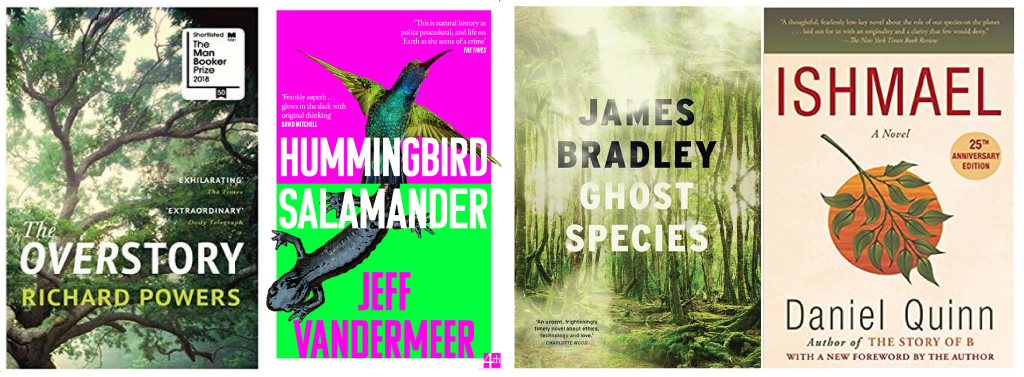
The following titles are highly recommended as a starting point for senior secondary and adult readers.
[1] I have used this spelling of Eco-fiction to mirror that used by John Stadler in his anthology of the same name containing a selection of short stories including: A sound of thunder by R. Bradbury, The turtle by J. Steinbeck. The conversation of Eiros and Charmion by E.A. Poe, The fair young willowy tree by A.E. Coppard, A mother’s tale, by J. Agee, The law by R.M. Coates, The birds by D. du Maurier, A stay at the ocean by R. Wilson, Jr., The supremacy of Uruguay by E.B. White, Look how the fish live by J.F. Powers, Tomorrow and tomorrow and tomorrow by K. Vonnegut, Jr., The white heron by S.O. Jewett, The Mary Celeste move by F. Herbert, The toys of peace by Saki (H.H. Munro), The subliminal man by J.G. Ballard, It’s such a beautiful day by I. Asimov, The hummingbird that lived through winter by W. Saroyan.
[2] Jim Dwyer. Where the Wild Books Are : A Field Guide to Ecofiction. University of Nevada Press, 2010.
[3] Ecocide has not been accepted as an internationally punishable crime by the United Nations. The only international recognition of ecocide is in the Rome Statute as a war crime where it is a crime to “Intentionally launch an attack in the knowledge that such attack will cause incidental loss of life or injury to civilians or damage to civilian objects or widespread, long-term and severe damage to the natural environment which would be clearly excessive in relation to the concrete and direct overall military advantage anticipated”.
Despite repeated attempts to recognise ecocide as a threat to peace, in particular by Scottish Lawyer Polly Higgins in 2010 and more recently by Vanuatu and the Maldives in 2019, ecocide is not a crime in peacetime. Ecocide can be defined as “The extensive damage to, destruction of or loss of ecosystems of a given territory, whether by human agency or by any other causes, to such an extent that peaceful enjoyment by the inhabitants of that territory has been severely diminished”. This definition includes damage caused by individuals, corporations and/or the State. https://en.wikipedia.org/wiki/Ecocide
[5] Schneider-Mayerson, Matthew. “The Influence of Climate FictionAn Empirical Survey of Readers.” Environmental Humanities, vol. 10, no. 2, 2018, pp. 473–500, read.dukeupress.edu/environmental-humanities/article/10/2/473/136689/The-Influence-of-Climate-FictionAn-Empirical, 10.1215/22011919-7156848.
[6] Lindgren Leavenworth, Maria, and Annika Manni. “Climate Fiction and Young Learners’ Thoughts—a Dialogue between Literature and Education.” Environmental Education Research, vol. 27, no. 5, 7 Dec. 2020, pp. 727–742, 10.1080/13504622.2020.1856345. Accessed 6 Nov. 2021.
[7] In both studies the potential for stimulating discussions was noted and suggested for further study.
[11] Adult readers in the study reported feeling “inspired”, “motivated” and forced to “reignite concerns they had let go idle” but also “angry”, “incredibly sad”, “helpless” and “guilty”. Many reported a realisation that climate change was a “slow moving violence” that also encompassed widespread social, cultural and political repercussions.
Armstrong, A. K., Krasny, M. E., & Schuldt, J. P. (2018). Communicating climate change : a guide for educators. Comstock Publishing Associates, An Imprint Of Cornell University Press.
Callison, C. (2015). How climate change comes to matter : the communal life of facts. Duke University Press.
Haydn Washington, & Cook, J. (2011). Climate change denial : heads in the sand. Earthscan.
Hayes, K., Blashki, G., Wiseman, J., Burke, S., & Reifels, L. (2018). Climate change and mental health: risks, impacts and priority actions. International Journal of Mental Health Systems, 12(1). https://doi.org/10.1186/s13033-018-0210-6
Hornsey, M. J., Harris, E. A., Bain, P. G., & Fielding, K. S. (2016). Meta-analyses of the determinants and outcomes of belief in climate change. Nature Climate Change, 6(6), 622–626. https://doi.org/10.1038/nclimate2943
O’Brien, K., Selboe, E., & Hayward, B. M. (2018). Exploring youth activism on climate change: dutiful, disruptive, and dangerous dissent. Ecology and Society, 23(3). https://doi.org/10.5751/es-10287-230342
Stevenson, K., & Peterson, N. (2015). Motivating Action through Fostering Climate Change Hope and Concern and Avoiding Despair among Adolescents. Sustainability, 8(1), 6. https://doi.org/10.3390/su8010006
Swim, J., Clayton, S., Doherty, T., Gifford, R., Howard, G., Reser, J., Stern, P., & Weber, E. (2010). Psychology and Global Climate Change: Addressing a Multi-faceted Phenomenon and Set of Challenges A Report by the American Psychological Association’s Task Force on the Interface Between Psychology and Global Climate Change Members. https://www.apa.org/science/about/publications/climate-change.pdf
Van Boven, L., Ehret, P. J., & Sherman, D. K. (2018). Psychological Barriers to Bipartisan Public Support for Climate Policy. Perspectives on Psychological Science, 13(4), 492–507. https://doi.org/10.1177/1745691617748966
Eco-Anxiety and Solastalgia are common responses to the distress caused by the effects of climate change – responses likely to be significantly intensified by the Australian summer of 2020. Young People and First Nations People are most severely affected.
On National TV, a young woman tearfully shares her conviction that motherhood in the near future is unsafe, unethical and a bad choice for the planet, while a young teenage protester asks for a curriculum that includes Climate Science, Media Literacy and Political Engagement.
At a “Schools Strike for Climate” rally a year 10 student talks about her fears for the future, her traumas framed by past experiences, and then, in blending pleas with demands, she calls on those in power to take action on Climate Change, care for the environment, listen to the Science and Tell the Truth.
But young people’s concerns are dismissed and they are told to study hard so they can fix the climate when they graduate. Understandably, they are increasingly becoming either extremely concerned about climate change or in denial.
“What if the problems we are causing in the natural environment are linked to the problems going on inside our heads?” asks Matt Haig (2019).
Eco-anxiety – an Appropriate Response
Eco-anxiety, the chronic fear of environmental doom, is an appropriate and reasonable response to the existential threat of climate change. With symptoms similar to other anxiety disorders, Eco-anxiety differs in that the threat posed by climate change is real so the fear is rational. Some refer to it a Pre-traumatic stress disorder – a fear of the future.
Anxiety is a common emotion, a protective mechanism. But “all anxiety contains a kernel of good news” said Rollo May observing that we would have no anxiety if we could not envision a future; anxiety contains an element of hope. In the face of the existential threat that is climate change, eco-anxiety is an appropriate response.
Understanding the “fight, flight or freeze” responses to anxiety helps to explain the varied and often polarised responses to Climate Change. For many, eco-anxiety is akin to the despair felt by Cassandra, whose gift of prophesy was frustrated by the curse of not being believed; they watch as the science is ignored in favour of populist alternatives that exacerbate the accelerating ecological destruction and make the scientific predictions even more likely. Some consider the subject too distressing or too difficult to understand, or refuse to acknowledge either that climate change exists or that it is anthropogenic. Some are overwhelmed.
However, only the fight response is considered to be the adaptive and healthy response to climate change, or, as the 350.org email informs me “Action is the antidote to despair”.
The Need for Stories
Advances in scientific knowledge have shown little or no correlation with changes in environmental attitudes or behaviour in relation to climate change. Science is bracketed out as complex, experimental and elite; knowledge is not transferring to power in tackling climate change. The lay person can feel shut out and inferior.
Stories can give a boarder audience a better sense of what is happening, framing responses and to making the science real and personal. Stories engage the emotions and reduce stress, opening the pathways to learning. Stories use metaphor and analogy to enable us to see ourselves and others from diverse perspectives, and to help us identify our values and build empathy. Stories can serve a didactic function, educating us through the voices of knowledgeable authors.
And stories have the power to motivate and inspire us by nurturing self-efficacy, optimism and resilience, which generate the hope and creative energy to act.
What is Cli-Fi?
Cli-Fi (Climate Fiction) novels are usually set in the present or the very near future with effects of climate change as a backdrop and a plot in which catastrophic events unfold amidst social and environmental upheaval. Young Adult (YA) Cli-Fi features teenage protagonists with absent or unhelpful adults and settings that are remain on a local level. The authors of YA Cli-Fi present readers with unsettling worlds, explore ways that families and relationships will be affected, the nature of heroes and villains, and how we might co-exist with the environment that we have callously disrupted.
Many Cli-Fi novels present readers with unsettling worlds where interpersonal trust has disappeared, where institutions that have previously been able to help have collapsed, where animals and plants have acquired new, monstrous properties and where even nature and the weather cannot be trusted. In these worlds, where we do not know how to distinguish good and bad, we are challenged to reflect on what is important to us, what our values are, what we need to preserve and what we are prepared to sacrifice.
In a version of Cli-Fi called ‘Solar punk’ writers opt to imagine a better, fairer world through their work. One Solar Punk writer, Sarena Ulibarri, acknowledges that “any near-future science fiction that does not engage with climate change is fantasy”.
In their didactic role, authors of YA Cli-Fi explain scientific terms and concepts, explore individual and government responses and address other unknowns for their readers, providing their readers with knowledge and empowerment and a positive perspective. By harnessing the emotions authors compel readers to recognise and act to foster change. In Cli-Fi we find heroes dealing with the impacts of climate change, adapting to the aftermath of natural disasters, and pressuring governments and corporations to act. We see alternative scenarios developed; what does martial law look like, what would you do to protect your family, or a bottle of water? Various and volatile combinations of fear, anxiety, confusion and anger, exist in Cli-Fi, and always with a message of hope.
Danish Cli-Fi researcher Gregers Andersen says (2020) “Cli-Fi plays a very significant role in helping people manage eco-anxiety. Climate fiction helps us to think about the future, gives us the opportunity to reflect on what it’s like to live in a climate collapsed world and make us realize the importance of changing to a more climate friendly way of life.”
Driven to Act
In the classroom, Cli-Fi has the potential to raise awareness in a non-threatening and non-personal way, motivating debate and inspiring action, and so potentially alleviating anxiety. Cli-Fi adheres to scientific accuracy, introducing concepts and language such as feed-back loops, tipping points, permafrost, gyres and gulf-streams that beget curiosity and discussion, and encourage research and investigation. Educators must ensure that climate change education cultivates hope and one way to do that is by empowering young people to be agents for change.
Cli-Fi can encourage us to focus our energies outwards. As we seek and connect with like-minded people, we feel less isolated, and we recognise our eco-anxiety as justified and valid. Within our new communities we can explore solutions, share problems and ideas, engage our imaginations, and learn ways to adjust to the future that is presenting itself; in the process we become less concerned with our own personal anxieties, begin to see the potential in action as an antidote for our anxiety and the possibilities in harnessing our energies for the greater good.
We find something worth fighting for; we are validated and empowered, unified and supported, and part of a global movement, huge and historical, that has come together to make the world a better place.
Paul Hawken describes this “Blessed Unrest” as “the greatest social movement in history … made up of environmental, social justice, and indigenous organisations, research institutes, community development agencies, village and citizen based organizations, corporations, networks, faith based groups, trusts, and foundations … from different economic sectors, cultures, regions, and cohorts … a global, classless, diverse and embedded movement spreading worldwide.” (from Eckersley 2007)
Eckersley identified three responses to fear of the apocalypse; Nihilism, Fundamentalism or Activism identifying “Activism: Where Hope Rules”, as the only adaptive response to the threats posed by Climate Change. Hope, formally defined as an awareness of strategies or pathways to achieve goals and the motivation to effectively pursue those pathways, has been identified as a strong predictor of recovery from anxiety disorders.
As sensations of hope inspires climate change action, and in turn, climate action generated by one’s peers can generates hope, people transform their anxiety into action as part of a united social mass of individuals who want to see a brighter future.
Driven to Adapt
But Cli-Fi has another purpose, and that is to show us our possible futures. When we read dystopian and science fiction novels, we explore other worlds with scant regard to how those worlds evolved. Cli-Fi fills in those gaps, forcing us to confront our grief and perhaps motivating us to fight harder to save those things we care about, to drive change, join rebellion and embrace activism. Cli-Fi introduces us to messages of survival; extreme weather, preppers, martial law, medical realities and societal and ecological systems collapse can all be explored in Cli-Fi.
Supportive fiction, by definition, nurtures Hope, Resilience, Self-efficacy and Optimism. But along the way we also explore and experience community, collaboration, empathy, laughter, relationships, values, alternative pathways and perspectives, validation, insight, catharsis, new information, new skills, universality, self-knowledge, self-acceptance, growth, healing, resolution, trust, alternative endings, escape, immersion, and a reframing. Good Cli-Fi can offer all of these.
Cli-Fi can help us adapt to a rapidly changing world by teaching us skills to build emotional resilience. Cli-Fi shows us that life goes on, allows us to live through our fears, disrupts our stuck thoughts and stimulates our imagination. Cli-Fi empowers us through information and understanding, knowledge and diversity and presents us with opportunities to reframe and possibly rewrite our futures. Cli-fi challenges us to accept that climate change is a fundamental part of being alive and allows us space to process the complicated feelings we have surrounding climate change. Writing original Cli-Fi can further help to process climate grief and build emotional resilience.
By inhabiting a warming planet within the pages of a Cli-Fi novel we will be better prepared to confront and respond appropriately to the unsettling and distressing realities of climate change; we will be better able to adjust to the realisation that our environment is changing rapidly and unpredictably; we will be more flexible and adaptable and able to identify the values and relationships most important to us; we will develop the emotional resilience to face the sadness and injustice accompanying climate change with courage and determination; we will identify our personal strengths and unique qualities; and we will learn that adaptation is not just coping, not just resilience, not just transformation but also the capacity to form meaningful connections with others.
Teaching Climate Change Without Creating Despair or Entrenching Denial
Is climate change education appropriate for children? Are we doom mongering? Even though the likelihood is that climate change will reach crisis point in their lifetimes, is this knowledge too great a burden for the young people in our care?
How do we raise a generation to look forward to the future with hope when all around them swirls a message of apparent hopelessness? How do we prepare today’s children for a world defined by trauma without inflicting further trauma ourselves? Where do we draw the line between responsible education and undue alarmism?
“Kids are terrified, anxious and depressed about climate change. Whose fault is that?” asks Jason Plautz (2020)
The link between Climate Change and the mental health of young adults is very real. A 2019 poll of USA teens found that Climate Change made 57% of them afraid and 52% of them angry, while just 29% said they felt optimistic.
The high school student thinks about climate change every day, she reads about how ecosystems are on the brink of collapse and listens in despair as her teachers and parents tell her that it’s up to her generation to fix things. She wonders if she will have children.
The second grader is scared about the planet but says it feels good to be surrounded by some many people (at the School Strike for Climate) who care, since he sometimes feels as if nobody else is worried. His parents are proud that their child is aware, but concerned that he could become overwhelmed by predictions that seem to be growing ever more disturbing.
And a sixth grade teacher wonders if he is violating his mandated responsibility to speak up about signs of abuse and neglect if he does not speak up forcefully about climate change and the institutions that prop up the “fictional story that you can care for kids in our country while neglecting or ignoring the climate”.
Psychiatrist Lise Susteren, expert for the plaintiffs in the Juliana vs United States Youth Climate Lawsuit (2018) is left with a sense of shame after interviewing children about their fears for nature and their worries about their future families.
Young people translate inaction by the older generations as telling them we don’t care about their future. By failing to address Climate Change in a meaningful way we are failing our young people and they know it.
Teachers have a responsibility to inform themselves about climate change so they can help young people work towards solutions and move away from rigid thinking, calm their fears about the future, and give them a sense of hope and optimism. Teachers must be prepared to empower their students by means of age appropriate knowledge, to nurture their sense of agency in their own lives, to help them recognize that the worst of climate change is not a fait accompli, to show them that solutions exist and that some progress can be made, and to encourage them to take action, be that at a personal level or as part of a larger group, as a way to process and alleviate climate change concerns.
Activism is a burden, but they should be encouraged to participate in some type of action, primarily because action is the best antidote for eco-anxiety but also to show them that they have agency in their future, and that their future is still being written.
Teachers, and parents, walk a tightrope between being honest and being comforting, between empowering young people with hope and weighing them down with the responsibility of saving the world.
Parents, also, must prepare their children to be ready to make good choices and be part of the society they will inhabit as adults. As one parent says, “It’s a disservice to our children if we don’t reach them about life’s dangers and how to protect themselves, even as we pray it will never be necessary.”
Activism or Despair?
Young people are both more susceptible to environmental-related trauma and less emotionally equipped to cope with the potential impacts. In the face of a disaster they are more likely to be affected by eroded social networks as communications fail, and more likely to be overwhelmed by grief, frustration, guilt, helplessness and anxiety in the aftermath.
Some young people must be asking “Am I sick or is the world sick?“ They might wonder “Am I the only one paralysed by eco-anxiety?” Some young people may be so overwhelmed that they retreat into avoidance and denial.
Some adults might say that it is the rhetoric surrounding climate change that is creating anxiety in young people. But children and adolescents will register our concerns via overheard conversations, news items, popular films that generate questions among their peers, or by experiencing the effects of wild weather and natural disasters unfolding around them.
They want a curriculum that prepares them for the uncertainties of a warming planet, with reliable information about the facts and the magnitude of the threat of climate change in honest, open and frank discussions with trusted and informed adults, whether in the classroom or around the dinner table, in ways they can understand.
Young people want their emotions and concerns acknowledged; they want to be able to make informed choices, and they want to feel empowered to make their own choices; to access and be able to influence policy makers; and they want to join with peers who think along the same lines.
Young people’s anxiety is fuelled by the inaction of adults even as it drives their activism. Scientist Owen Gaffney says that Eco-anxiety is the right response to the scale of the Climate Change. Yet according to marine biologist Tim Gordon “there’s a huge amount we can still do to protect what’s left and make a meaningful difference.” Young people need to receive this message.
The Role of Cli-Fi
“All great literature is subversive if not downright revolutionary” says John Marsden. “It’s important for novelists to challenge false thinking, to question, to blaze trails.”
All literature influences and models the world for readers, defining, describing and explaining the world, and challenging and shaping our values through the actions and voices of heroes and villians.
Scott Westerfeld argues that his work is not designed to manipulate the political preferences of adolescents, but rather to provide them with a forum to discuss issues and strategies for political activism and social change.
In the novel “I am David” Anne Holm’s protagonist says “Can’t you understand that children have a right to know everything that’s true? If there’s danger you have to recognize it or else you can’t take care of yourself.”
And so, in the style of G. K. Chesterton we might say …
Cli-Fi does not exist to tell children that Climate Change is real. Children already know Climate Change is real. Cli-Fi exists to tell children that Climate Change must be confronted.
Students need school librarians and dedicated reading programs to enhance their mental health and wellbeing.
Not only does reading fiction help adolescents navigate personal and emotional development during their teens, but developing a reading habit can help to mitigate the disruptive effects of mental health throughout their entire lives.
What’s special about stories?
Stories show us that it’s okay to fail, that mistakes are opportunities for learning, that courage isn’t an absence of fear, and that not everyone is as they seem.
Stories help us identify and refine our values and ideals, show us what resilience looks like, help us to define our goals and encourage us to explore our emotions.
Stories reflect and validate our lived experiences, help us to accept our past, help us to create order from our chaotic lives, and encourage us to be optimistic about the future.
Stories comfort us, help us connect with others and make us feel less alone.
Stories reframe our problems, help us create distance and see different perspectives, and nurture optimism, hope and self-efficacy.
Stories promote empathy and compassion, remove stigmas and stereotypes, help us to embrace diversity and show us a wider view of normal.
Stories introduce us to ancient wisdom and create intergenerational connections.
Stories help us to understand our world, help us to recognize the importance of our own life story as part of a bigger picture and help us to be more accepting of ourselves.
Stories give us answers to questions we don’t know how to ask.
Stories stimulate our imagination.
Stories give us role models to inspire us to persevere and improve, to empower us to speak out, to join in celebrating the successes of others, and to help us to be grateful and accepting of ourselves.
Stories give us the insight, the language and the confidence to seek help when we need to share our concerns or can’t manage alone.
Stories are not only the easiest way but sometimes the only way to learn about ourselves, and find our place in the society and the world we inhabit, from a safe and secure place.
Who can ensure our students are learning these things if not the teacher librarian?
Why is a Teacher Librarian is the best person to implement Developmental Bibliotherapy?
Teacher Librarians love to talk about books and Teacher Librarians provide guidance, encouragement opportunities for learning without grades.
NOTE: Books do not judge and neither should librarians – remember that in developmental Bibliotherapy activities there are no wrong answers.
Developmental Bibliotherapy occurs when Young People recognize that a change has taken place in their Thoughts, Feelings, Actions or Beliefs.
Implementing
Developmental Bibliotherapy is about asking the right questions to help this
self reflection to take place. It can take as little as fa few minutes as an
informal chat, or it can be developed into a unit of work.
Whether
as an informal chat, recalling an event or quote from a novel, creating a piece
of artwork or writing a book review, Developmental Bibliotherapy is almost
certainly taking place in every library wherever a skillful teacher librarian is
talking to young people about the books they are reading.
Go to the Activities and Printables page for ideas on Implementing Developmental Bibliotherapy or ways you can ensure that your existing programs are creating the conditions for change.
If an activity results in the reader reflecting and articulating a positive change in theirThoughts, Feelings, Actions or Beliefs then Developmental Bibliotherapy has been in action.
Although reading fiction is not a panacea, by showing young people a wider view of normal, by allowing them to explore their emotions and their identity alongside fictional heroes, by removing stigmas and stereotypes and by giving them the language and the confidence to seek answers from trusted adults, Developmental Bibliotherapy programs gives students skills that can promote better mental health outcomes throughout their lives.
When children read about ordinary people achieving extraordinary successes, they come to realize that the brain is flexible and adaptable, and that intelligence, like confidence, can be also be developed – they adopt a “growth mindset”
How can we immunize young people against the disruptive force of mental illness? Joseph Gold (2001)
By ignoring the potential of books in the development of Core Confidence in young people we are depriving them of the opportunity to develop this most vital aspect of their being.
Alexander Stajkovic’s theory of Core Confidence says that Confidence resides unseen in the core of an individual’s character, and is manifested in Hope, Self-efficacy, Resilience and Optimism. These distinct but interconnected elements can predict job satisfaction, job performance and, ultimately, satisfaction with life. Furthermore, Stajkovic believed that these elements can be cultivated in all of us.
I believe they can be cultivated in young people using Developmental Bibliotherapy.
Cultivating Core Confidence with Books
Self-efficacy
“The moment you doubt whether you can fly, you cease for ever to be able to do it.”
Peter Pan in J.M. Barrie’s book of the same name.
Self-efficacy refers to the belief in one’s ability to produce a given level of attainment. It is disctinct from but related to self-esteem, motivation and resilience.
Self-efficacy influences the goals that we choose for ourselves, the confidence in our ability to learn new tasks and especially, whether we believe that abilities can be learned and developed or are fixed.
Unsurprisingly, mastery of a skill is the most powerful way to build self-efficacy. Through mastery we see that skills can be acquired and as our self-efficacy increases we are encouraged to attempt still more new skills. But influential people in our lives can also strengthen our self-efficacy – with meaningful feedback, encouragement and support we are motivated to greater efforts.
The second most powerful way to cultivate self-efficacy is through Vicarious Learning – watching or reading about people, especially role models, succeeding by their sustained effort raises our beliefs in our own abilities, much the same way that an outstanding team member can raise the achievements of less talented players in a team.
Whether we are reading horror and suspense, romance or an autobiography, mirror neurons respond to the emotions and triumphs of characters as if they were our own. And as our brains are flooded with the thoughts and experiences of characters within the pages of a book our brain is leaning vicariously – imagining conversations, testing alternatives and refining our beliefs.
Hope
“Hope can be a powerful force. Maybe there’s no actual magic in it, but when you know what you hope for most and hold it like a light within you, you can make things happen, almost like magic.”
Laini Taylor in Daughter of Smoke & Bone
Hope has the power to heal afflictions and helps us endure times of great suffering. Hope has a very positive impact on health, academic achievement, athletic accomplishment, emotional health, personal meaning and our ability to cope with adversity.
Hope has a positive impact on health, academic achievement, athletic accomplishment, emotional health, personal meaning and our ability to cope with adversity. Hopeful thinking is both a trait and a positive motivational state. We think of Hope as being made up of Pathways towards achieving a goal and the determination to achieve a certain goal known as Agency).
We cultivate Hope by visualising multiple pathways towards our goal, by maintaining our motivation towards achieving that goal and by believing in our power to achieve our goal.
“No matter what sort of difficulties, how painful experience is, if we lose our hope, that’s our real disaster.”
Dalai Lama XIV
But to cultivate Hope we must first identify our dreams; and our dreams emerge once we recognize those things we value in ourselves, our relationships and our environment.
Literature helps us to identify our values and decide what is important to us by guiding us through self-reflection. As we share the hopes and disappointments of fictional characters facing obstacles in their fictional quest, we learn to be flexible and adaptable, we visualize alternative strategies towards our own quests, we learn that setbacks and detours are obstacles to be overcome; and we begin to imagine our own paths and dreams.
“The idea of a happy ending is a very powerful thing. Living in a world without hope would be very bleak indeed”.
Josh Dallas (Once Upon a Time)
We accompany characters as they make mistakes and choices, forge relationships and face dangers and we learn to predict, to envisage alternative actions and to consider “what if” outcomes. As we follow, and sometimes identify with, the fictional character on their quest, we learn to forgive their mistakes and transgressions, and we develop empathy and compassion.
Optimism
“What day is it?” asked Pooh. “It’s today,” squeaked Piglet. “My favorite day,” said Pooh.”
A.A. Milnein Winnie the Pooh
Optimism is the belief that we are responsible for our own happiness and that more good things will happen to us in the future. For optimism to be a positive force this belief must be realistic – appreciating the positive aspects of a situation without ignoring the negative – and our belief must allow for the possibility that bad things do happen to good people.
Optimism can affect our personal growth, our sense of purpose in work, our relations with others, our pride in our accomplishments, and our general level of happiness and life satisfaction. Optimistic students are less susceptible to stress, loneliness and depression, and less likely to drop out. Optimists are also more likely to have healthy lifestyles.
Literature helps to cultivate our optimism by helping us escape the limitations of our environment and negativity from our influencers. Literature stimulates our imagination and enables us to organise our own experiences while in the process of deciphering someone else’s. Literature helps us to make sense of the past and become less fearful of an uncertain and sometimes terrifying future.
Resilience
“It came to me that I hadn’t known that I was less than I could have been until then, when I saw there was so much more of the world for me to be myself within.”
Griz in “A Boy and His Dog at the End of the World” by C. A. Fletcher
Resilience is the ability to take responsibility for creating the future we want, to persevere through everyday adversities and tribulations, to adapt or overcome major setbacks, and to reach out to new experiences and challenges.
Resilience transforms hardship into challenge, failure into success, helplessness into power, victims into survivors and allows survivors to thrive.
Resilience comes when we believe that we have the power to control the events in our life and to change the things that need changing, and that belief is accurate. Resilience is not a trait that one either has or does not have; resilience is a state that involves behaviours, thoughts and actions, and it can be learned and developed.
Resilient individuals seek connections, they accept help and they try to help others.
Resilient individuals accept change as a path to growth.
Resilient individuals can recognise and articulate feelings, needs and viewpoints and are open to the opinions of others.
Resilient people stay curious about their world, and about the past and the future, and they are reflective and mindful of their own and others’ thoughts and emotions.
Resilient people maintain a positive self-image, a sense of perspective and derive meaning from failure.
Resilient people are see obstacles as ambitious but attainable tasks.
Resilient people enjoy learning new skills and use creative experiences to bolster their wellbeing.
Fictional characters can inspire us to develop our own resilience by watching them develop through the choices and responses they make. We learn that resilience is something that we cultivate, not something we are born with, and that sometimes resilience requires immediate action, but most often it does not. We see that resilience involves a realistic evaluation of a situation, to consider for alternative solutions, to be less reactive to our emotions, and to respond better when adversity strikes.
The Danger of Excess
It is possible to have too much of these elements of Core Confidence:
Too much Self efficacy can make us over confident and we neglect our training, we believe we have nothing left to learn, or we reject new ideas and suggestions.
Too much Hope can anesthetise us, keeping us passive when we should be motivated into action.
Too much Optimism can shroud us in illusions and irrational beliefs, or cause us to waste energy on unattainable goals.
Too much Resilience can make us overly tolerant of adversity, or make us resigned and apathetic in the face of danger.
Hope, Resilience, Self-efficacy and Optimism are states that amalgamate to form Core Confidence, so interdependent that when one is out of balance, the others will fail alongside it or fall behind and either way our Core Confidence is diminished. So it is far better to have too much Core Confidence than too little.
Developmental Bibliotherapy and Core Confidence
Joseph Gold (1998) describes the beneficial power of fiction thus: “Fiction extracts the reader from their immersion in personal confusion … using narrative to engage the reader emotionally while generating new and newly arranged information so that cognitive shift can take place. The results of this are improved problem solving skills, a greater sense of normality, a breakup of rigid and confusing cognitive frameworks, improved socialization and increased self-actualization.”
Developmental Bibliotherapy has the advantages over other all programs in that it can be infinitely tailored to meet the needs of almost any student. It can be practiced anywhere at any time, alone or in a group, at any age.
And the resources necessary to implement Developmental Bibliotherapy are already abundant in most schools.
By ignoring the potential of books in the development of Core Confidence in young people we are depriving them of the opportunity to develop this most vital aspect of their education.
“I was seeing the world through the lens of the books I had read about it”
Griz in “A Boy and His Dog at the End of the World” by C. A. Fletcher
If we could design a program for young adults with the aim of boosting good mental health, like a wellbeing vitamin, what would such a program look like?
Which personal qualities enable some young people to ride the rollercoaster that is adolescence and emerge confident that they can forge their own path within the society they are set to inhabit?
And how we can provide children and young adults with the education that enhances their own particular strengths?
Attributes and Character Strengths for the 21st Century.
Twenty first century teens face enormous educational, social and global pressures reflected by escalating numbers of young people with mental health issues.
Alexander Stajkovic proposed that Core Confidence, made up of Self efficacy, Resilience, Optimism and Hope, form an inner resource which helps us avoid being crushed by the setbacks we face during our lives.
Martin Seligman suggested that we are better placed to overcome challenging situations if we can eliminate Personalisation, Permanence and Pervasiveness from our set of personal beliefs. Seligman also revisited the term “Positive Psychology”, and identified 24 Signature Strengths, in five broad groups, that we can use or develop to achieve our potential for wellbeing, happiness and fulfilment (including seven key attributes – Self Control, Zest, Social Intelligence, Gratitude, Optimism, Curiosity and Grit, “a perseverance and passion for long-term goals” – can predict academic success).
At Camp Kulin, Western Australia, life skills such leadership, respect, trust, self confidence, self respect, self esteem, emotional regulation, anger management and perseverance are shown to improve personal, behavioural and academic outcomes for their adolescent participants.
And, John Marsden, Australian author and school principal, in saying that “by limiting children’s exposure to danger, to fear, we are limiting their ability to mature, develop resilience and independence”, reinforces recent findings that children need to experience failure and risk.
How do we kindle these qualities in young people; how do we nurture them into self sustaining personal attributes?
Research tells us that we can do this by simply encouraging children to read!
What’s Special About Books?
When a child first becomes an independent reader, they proudly, confidently and independently begin to explore new worlds. Inside the covers of books they meet new characters, confront questions and find answers, develop creativity and imagination; and they no longer rely on others for entertainment. They are separating from their parents while simultaneously taking steps towards becoming members of the grown-up world; able to communicate and share stories beyond their own limited experiences.
As children
read they learn that they can experience things as individuals, they become
confident communicators, they become creative problem solvers, and they start
to understand, recognise and relate to emotions. Their brain is learning
vicariously, and these new skills, characteristics and attributes accompany
developments in cognitive skills (thinking, problem solving, reasoning,
remembering and concentration).
As they read they begin to develop a Theory of Mind – able to consider others’ perspectives and needs – and so they start to develop empathy and start caring for others. They learn about diversity as they read stories about how other people (or animals, or imaginary creatures like fairies, or inanimate objects like pencils) go about their lives, expressingr emotions and coping with different problems and situations.
But they also learn that others experience similar feelings to themselves, such as nervousness, fearfulness or anger, and they begin to explore these feelings from a safe place within the pages of a book. They learn that sometimes bad things happen, sometimes good people fail and sometimes life isn’t fair, but that these times don’t last forever.
Characters in these first stories can help children start to think about how they want to live their lives and their own place in the world, and they help readers to explore different opportunities and possibilities. Children are developing and reflecting on their own personal values, but they are also confronting fears, taking risks, accepting failure, forming friendships, breaking barriers, challenging stereotypes and exploring alternative worlds, safely within the worlds inside a book.
Along the journey from childhood to adulthood, young adults must balance pressures from family, school, friends and often social and cultural expectations, with a personal need to explore their potential, develop and express their individual values and styles, and test their own boundaries as they reflect on what it means to live “the good life”. Many are terrified in the knowledge that their generation is facing an uncertain future with unforeseeable problems.
Young adult readers find role models among the authentic characters created by respected Young Adult authors, perhaps in addition to the adults in their lives or perhaps in the absence of trustworthy adults, to assist and guide them during their teen years.
Bibliotherapy and the Default Mode
Network.
The Default Mode Network is a group of connected regions in the brain, which is most associated with task-unrelated thinking and has been described as “The brain running in neutral” activated “precisely when we detach ourselves from what’s going on around us” (Noë, 2017).
The Default Mode Network is responsible for:
Autobiographical Memory – forming our personal memories and our understanding and reflection of ourselves, including our strengths and our emotions;
Social information – developing a Theory of Mind, empathy, moral reasoning, intuition, stereotyping, social skills;
Applying Memories – recalling the past, imagining the future, comprehending narratives;
Spontaneous Thought – contributing creativity in problem solving and AHA moments as well as enabling rapid automatic and instinctive reactions.
The Default Mode Network is most active when daydreaming, during REM sleep and while reading. Disruption in Default Mode Network connectivity has been linked to mental health issues including depression, schizophrenia and Alzheimer’s.
The Default Mode Network is responsible for continually storing and applying learned information, enabling us to make sense of the chaotic and disconnected events that we encounter daily. It is active whenever we are thinking about ourselves or others, when we are remembering the past or using our past experiences to plan for the future, when we are interacting in social contexts and finding our place in the world, and when we are exploring our creativity and testing our boundaries.
Default Mode Network is activated when we read because it supports our capacity to simulate hypothetical scenes, spaces and mental states; we must access our memories in order to understand the story we’re reading.
It is the function of the Default Mode Network (DMN), and its relationship to reading and mental health, that presents the most compelling case for more Developmental Bibliotherapy in schools.
Conclusion
It is important to acknowledge that there are many categories falling under the mental illness diagnosis, and within these categories there are different underlying causes. These causes can be classified as biological, psychological and social.
Furthermore, the difficulty of separating developmental issues from abnormal problems that require medical intervention (or as Australian comedian Alice Fraser describes it “a disaster thing or a coming-of-age thing”), the difficulties in diagnosing young people in whom emotional issues present as physical problems and uncovering hidden problems in young people who may struggle with language or trust, add to the complexities in the diagnosis and treatment of childhood and adolescent mental health.
However, all
evidence indicates that early intervention is the key to minimising the impact
of mental illness. Bibliotherapy increases the likelihood of early intervention
by providing language and opening communication with trusted adults, by
addressing Seligman’s “3Ps” by portraying characters in similar situations, by
removing stigmas and shattering stereotypes, by increasing empathy and representing
diversity, by reducing fear and isolation, and by representing a wider view of
normal.
Learning
from the experiences of fictional or real characters enables all of us to stand
on their shoulders and thus experience a wider view of ourselves, the world and
our place in it, and forces us
to ask what type of life and world do we want for ourselves.
The evidence
is clear – the most cost-effective way to provide mental health benefits to
children and young adults begins with supporting school libraries, employing qualified
library staff and timetabling meaningful library programs.
“Fairy tales do not tell children that dragons exist. Children already know that dragons exist. Fairy tales tell children that dragons can be killed.” G. K. Chesterton
What is Developmental Bibliotherapy?
Developmental Bibliotherapy is a branch of Bibliography which usually takes place as part of a secondary school reading program using young adult fiction and designed to help young people navigate the many issues they encounter during their adolescence.
Inside contemporary Young Adult Fiction, authors create authentic characters and anticipate their readers’ questions and concerns. Teens gain insights from characters living in similar situations, validating readers’ experiences and introducing them to language and options that may not have been previously known to them.
In this way, Young Adult Fiction becomes an effective way to break down the stigmas and stereotypes that are the major barrier preventing young people from seeking help for themselves or for others.
The objective of Developmental Bibliotherapy is to change readers’ Thoughts, Feelings, Actions and Beliefs, especially related to mental health issues, enabling conversations and addressing fears, so that issues can be identified and addressed as early as possible.
And yet, while Developmental Bibliotherapy is easily incorporated into most school reading programs, its potential for changing the lives of young people by building resilience and equipping them with skills in preparation for a crisis or a troublesome situation, has not been given sufficient attention in the fight to save school libraries and librarians.
At a time when our children and young adults need their stories told more than ever, schools are ignoring the potential within the school libraries by trimming library budgets, abandoning library programs in favour of academic programs and moving teacher librarians into classrooms.
We need stories to experience what it’s like to survive the unsurvivable; to find light in the darkest night.
Jeff Zetner
During their teens, young adults refine their personal expectations, desires and values while simultaneously facing pressures and expectations from their peers, the adults around them, and the wider community.
Adolescence may involve issues of gender and sexuality, physical or mental illness, different ability and disability, otherness, grief, guilt, family issues, mental illness, addiction, sexual assault, relationship issues, peer pressures and significant life decisions, in addition to preparing for the 21st century issues that will confront them as an adult.
Young Adult fiction is becoming more edgy, reflecting readers’ desire for stories dealing with these ‘difficult’ and sometimes controversial topics. Young adults want to see characters who are empowered, informed and able to build fulfilling lives – developing coping strategies and participating in meaningful relationships even while accepting the setbacks confronting them.
Authors of contemporary Young Adult fiction are aware of their responsibility to represent the concerns and experiences of their audience respectfully and realistically in a way that is accessible and authentic without being didactic. In turn, Young Adult readers trust authors to give them accurate and relevant information, and answers to questions they may not know how to ask, in storylines that mirror the difficult issues they see amongst their peers.
Mental Health
In 2019, 70% of US teens, identify anxiety and depression as their major concern, either for themselves or as a concern for their peers.[ii] Australian young adults are no different. On average, one in seven young Australians currently in secondary education will experience one of the common mental health illnesses in any given year.[iii] Others will experience mental health issues as a carer or see a family member experiencing mental health issues.
On average, one in seven young Australians currently in secondary education will experience one of the common mental health illnesses in any given year. Others will experience mental health issues as a carer, friend or family member of someone experiencing mental health issues.
We experience good mental health as being in control of our emotions, able to make well considered decisions and having positive interactions with people around us. We meet life’s challenges with confidence in our own abilities, or seek help when we need it. We might say that our resilience is high.
When our mental health is poor, our resilience is low, and we become confused and fearful. Setbacks often escalate into more serious issues that significantly disrupt our daily activities and relationships. And although early intervention can minimise the amount of disruption caused by a mental illness and increase the rate of recovery, we are fearful and reluctant to seek help because of the common stereotypes and stigmas that surround mental illness.
And, while most teens readily discuss most aspects of their lives on social media, few feel able to discuss mental health concerns on these platforms.
Young people need access to an adult they can trust – non-judgemental, discreet and knowledgeable and available – to discuss their concerns. It has been said that one trusted adult can make a significant difference to an adolescent’s outcomes. Amongst their most trusted adults are teachers, librarians and the authors who speak through characters with whom they can identify.
Characters in Young Adult literature, introducing language to describe their experiences, enable readers to articulate their own experiences and help them facilitate their own real life conversations. Characters’ actions and experiences answer readers’ questions, validate their experiences, identify symptoms, explore options and explain treatments in ways that reduce the fear, eliminate the stigmas and shatter the stereotypes that may be preventing young people from discussing the way they are feeling or from seeking help.
Books … explain us to ourselves and to others, and make us feel less strange, less isolated and less alone.
Alain de Botton
Furthermore, as young people read about fictional characters experiencing a mental illness, they develop empathy, becoming more supportive of others with a mental illness, and feeling more able to seek help for friends or family members who may be unable to take the effective action needed to help themselves.
Being supported and equipped with appropriate vocabulary gives young people the confidence to share troubling thoughts and feelings with others and do so sooner, which improves the chances of better outcomes.
Developmental Bibliotherapy
implemented by teachers, parents, librarians and counsellors can be a
preventative strategy for teens but should not be seen as a substitute for
long-range therapeutic intervention by a psychologist or psychiatrist where
necessary. Bibliotherapy is not a panacea but it can be an effective adjunct to
other treatments.
For Developmental Bibliotherapy to
have meaningful benefits, it requires cooperation, reading ability and desire
on the part of the reader, a positive relationship between the reader and the
therapist, and a skilful matching of reader with quality YA literature.
School based Developmental
Bibliotherapy programs need to include guided discussions and planned
activities if they are to maximize positive outcomes.
The Benefits
Humans are the story species – the only species able to communicate across time and space. Stories have helped us survive as a species; by increasing our ability to make decisions, solve problems and deal with stress and change, by allowing us to safely test out courses of action, by improving social communication, and by learning from others’ mistakes.
Bibliotherapy, the use of stories for personal growth and emotional healing, predates the written word. It is thought that storytelling emerged when primitive peoples harnessed fire and extended their wakening hours beyond sunset. Stories soothed fears, answered questions, stored knowledge, related heroic exploits and guided our physical and spiritual journeys.
Fiction validates our emotions and experiences, and fortifies our resilience. When we read fiction we learn vicariously. Fiction provides us with a safe place from which to explore our thoughts and feelings, and provides opportunities to rehearse our interactions with others.
Fiction promotes empathy by introducing us to diverse communities and showing us a wider variety of normal. Reading fiction provides us with models, helping us to define our boundaries and our values, and find answers within ourselves. And, by seeing our experiences in written form, fiction gives us the language to express ourselves.
Fiction helps us relieve stress and emotions in a controlled manner, gain insight into our own behaviour, see different perspectives and find alternative solutions. It allows us to see others experiencing similar problems so we feel less isolated and alone, and prepares us for some of the issues we may be anticipating with dread, encouraging us to face problems before they escalate.
Developmental Bibliotherapy must be implemented more widely in schools. It is an effective technique for helping children with a variety of topics – the advantages are many and the disadvantages are few.
If literature is a really important human resource, how can we accept a situation that tolerates the loss of this resource to millions of people?








 Read For Life