
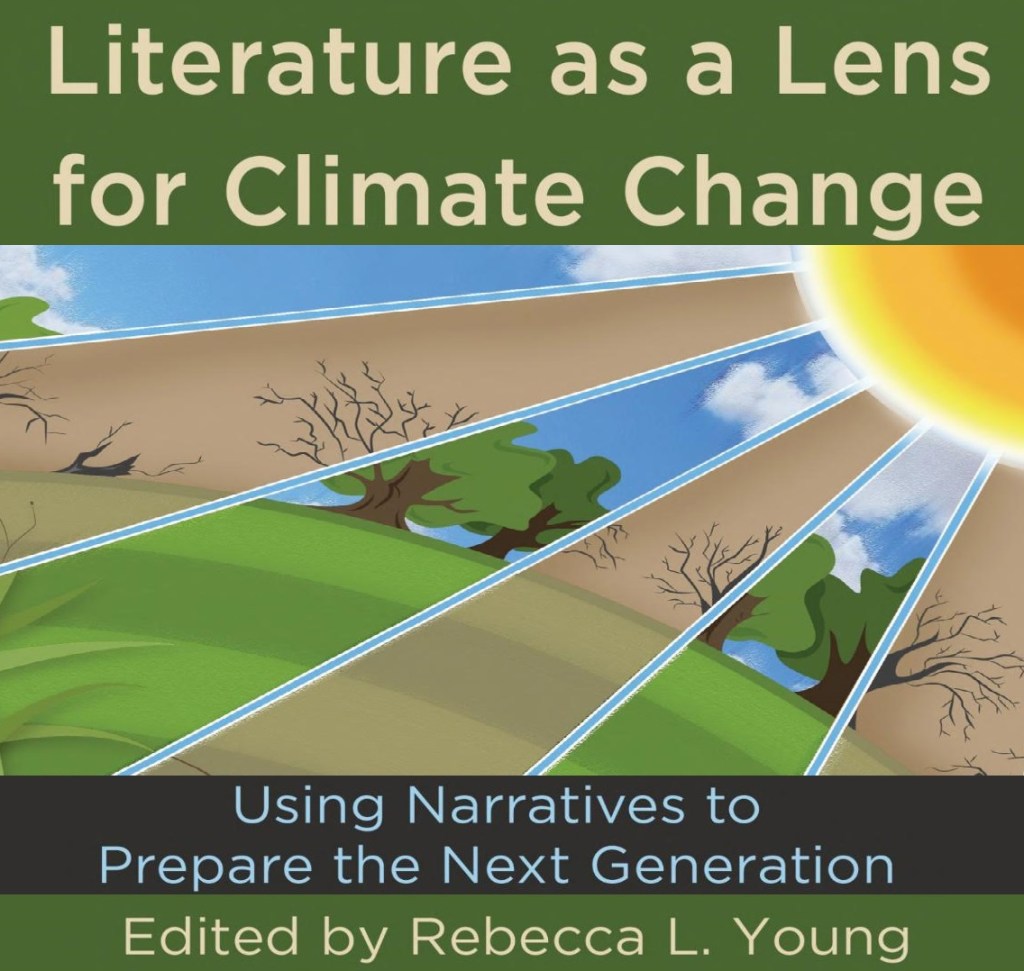
My contribution to Literature as a lens for climate change (in 5 parts)
Young, R. L. (2022). Literature as a lens for climate change : using narratives to prepare the next generation. Lexington Books.
Listen here or Subscribe to Developmental Bibliotherapy Podcasts on Spotify
Part 1 Introduction: Teaching Climate Change without Creating Despair or Entrenching Denial
Part 2 Activism: Where Hope Rules
Part 3 Harnessing the Power of Stories
Part 4 Reading and Well-Being
Part 5 Developmental Bibliotherapy and CLi-Fi
References
Albrecht, Glenn. 2012. “The Age of Solastalgia.” The Conversation. August 7, 2012. https://theconversation.com/the-age-of-solastalgia-8337.
American Library Association. 2017. “Professional Ethics.” Tools, Publications & Resources. May 19, 2017. http://www.ala.org/tools/ethics.
Andersen, Gregers, and Carsten Munk Hansen. 2014. “Fiction Prepares Us for a World Changed by Global Warming.” Humanities.ku.dk. University of Copenhagen. November 10, 2014. https://humanities.ku.dk/news/2014/fiction_prepares_us_for_a_world_changed_by_global_warming/.
Bandura, Albert. 1978. “Self-Efficacy: Toward a Unifying Theory of Behavioral Change.” Advances in Behaviour Research and Therapy 1 (4): 139–61. https://doi.org/10.1016/0146-6402(78)90002-4.
Cohen, Stanley. 2015. States of Denial : Knowing about Atrocities and Suffering. Cambridge, Uk: Polity ; Malden, Ma.
Duggan, Joe. n.d. “This Is How Scientists Feel.” Is This How You Feel? Accessed June 25, 2021. https://www.isthishowyoufeel.com/this-is-how-scientists-feel.html.
Eckersley, Richard. 2008. “‘Nihilism, Fundamentalism, or Activism: Three Responses to Fears of the Apocalypse’ by Eckersley, Richard – the Futurist, Vol. 42, Issue 1, January-February 2008 | Online Research Library: Questia.” The Futurist 42 (1). https://www.richardeckersley.com.au/attachments/Futurist_Apocalypse_2008.pdf.
Edwards, Sarah Anne. 2008. “Eco-Anxiety: An Intelligent Response.” Eco-Anxiety. March 20, 2008. http://eco-anxiety.blogspot.com/2008/03/by-sarah-anne-edwards-phd-lcsw-articles.html.
Gold, Joseph. 2001. Read for Your Life : Literature as a Life Support System. Markham, Ont.: Fitzhenry And Whiteside.
Kelly, Claire M, Johanna M Mithen, Julie A Fischer, Betty A Kitchener, Anthony F Jorm, Adrian Lowe, and Chris Scanlan. 2011. “Youth Mental Health First Aid: A Description of the Program and an Initial Evaluation.” International Journal of Mental Health Systems 5 (1): 4. https://doi.org/10.1186/1752-4458-5-4.
Konrath, S. H., E. H. O’Brien, and C. Hsing. 2010. “Changes in Dispositional Empathy in American College Students over Time: A Meta-Analysis.” Personality and Social Psychology Review 15 (2): 180–98. https://doi.org/10.1177/1088868310377395.
Kringelbach, Morten L., and Kent C. Berridge. 2009. “Towards a Functional Neuroanatomy of Pleasure and Happiness.” Trends in Cognitive Sciences 13 (11): 479–87. https://doi.org/10.1016/j.tics.2009.08.006.
Lilleslåtten, Mari , and University of Oslo. 2020. “Climate Change Impacts Nordic Literature – Department of Linguistics and Scandinavian Studies.” Www.hf.uio.no. March 5, 2020. https://www.hf.uio.no/iln/english/research/news-and-events/news/2020/climate-change-impacts-nordic-literature.html.
Lopes, Lunna, Cailey Muñana, and 2019. 2019. “The Kaiser Family Foundation/Washington Post Climate Change Survey – Main Findings – 9349.” KFF. September 16, 2019. https://www.kff.org/report-section/the-kaiser-family-foundation-washington-post-climate-change-survey-main-findings/.
Macmillan, Jade. 2021. “Deputy Prime Minister Flags Excluding Agriculture from 2050 Climate Target.” Www.abc.net.au. ABC. February 7, 2021. https://www.abc.net.au/news/2021-02-07/michael-mccormack-flags-excluding-agriculture-climate-target/13130160.
Marsden, John. 2019. The Art of Growing Up. Sydney, N.S.W.: Pan Macmillan Australia.
Merzian, Richie, Audrey Quicke, Ebony Bennett, Rod Campbell, and Tom Swann. 2019. “Climate of the Nation 2019 Tracking Australia’s Attitudes towards Climate Change and Energy.” https://australiainstitute.org.au/wp-content/uploads/2020/12/Climate-of-the-Nation-2019-WEB.pdf.
Mission Australia , and Black Dog Institute. 2017. “Youth Mental Health Report : Youth Survey 2012-16.” Sydney, N.S.W.: Mission Australia. https://blackdoginstitute.org.au/docs/default-source/research/evidence-and-policy-section/2017-youth-mental-health-report_mission-australia-and-black-dog-institute.pdf?sfvrsn=6.
Morehead, James. 2016. “Stanford University’s Carol Dweck on the Growth Mindset and Education.” OneDublin.org. OneDublin.org. April 18, 2016. https://onedublin.org/2012/06/19/stanford-universitys-carol-dweck-on-the-growth-mindset-and-education/.
Noe, Alva. 2019. “NPR Choice Page.” Npr.org. 2019. https://www.npr.org/sections/13.7/2016/06/17/481977405/why-do-our-minds-wander.
O’Brien, Karen, Elin Selboe, and Bronwyn M. Hayward. 2018. “Exploring Youth Activism on Climate Change: Dutiful, Disruptive, and Dangerous Dissent.” Ecology and Society 23 (3). https://doi.org/10.5751/es-10287-230342.
Oades, Lindsay G., Aaron Jarden, Hanchao Hou, Corina Ozturk, Paige Williams, Gavin R. Slemp, and Lanxi Huang. 2021. “Wellbeing Literacy: A Capability Model for Wellbeing Science and Practice.” International Journal of Environmental Research and Public Health 18 (2): 719. https://doi.org/10.3390/ijerph18020719.
Olsen, Marci. 2006. “Bibliotherapy: School Psychologists’ Report of Use and Efficacy BYU ScholarsArchive Citation.” Scholars Archive. https://scholarsarchive.byu.edu/cgi/viewcontent.cgi?article=1408&context=etd.
Ortiz, Diego Arguedas. 2019. “How Science Fiction Helps Readers Understand Climate Change.” Www.bbc.com. BBC. January 15, 2019. https://www.bbc.com/culture/article/20190110-how-science-fiction-helps-readers-understand-climate-change.
Pew Research Center. 2019. “Most U.S. Teens See Anxiety and Depression as a Major Problem among Their Peers.” PEW Research Center. https://www.pewresearch.org/social-trends/wp-content/uploads/sites/3/2019/02/Pew-Research-Center_Teens-report_full-2.pdf.
Richards Bodart, Joni, Ashley N. Barrineau, and Mary L. Flamino. 2011. “The Printz Award Winners under a Microscope: Content Trends, Committee Challenges, and Teen Popularity.” The Journal of Research on Libraries and Young Adults. Young Adult Library Services Association. http://www.yalsa.ala.org/jrlya/2011/02/the-printz-award-winners-under-a-microscope-content-trends-committee-challenges-and-teen-popularity/.
Rubin, Rhea J. 1979. “Uses of Bibliotherapy in Response to the 1970s.” Library Trends 28 (2): 239–52. https://eric.ed.gov/?id=EJ212852.
Stajkovic, Alexander D. 2006. “Development of a Core Confidence-Higher Order Construct.” Journal of Applied Psychology 91 (6): 1208–24. https://doi.org/10.1037/0021-9010.91.6.1208.
Stark, Eloise A., Peter Vuust, and Morten L. Kringelbach. 2018. “Chapter 7 – Music, Dance, and Other Art Forms: New Insights into the Links between Hedonia (Pleasure) and Eudaimonia (Well-Being).” Edited by Julia F. Christensen and Antoni Gomila. ScienceDirect. Elsevier. January 1, 2018. https://www.sciencedirect.com/science/article/pii/S0079612318300190.
The Australian Psychological Society Limited. 2019. “Young People’s Voices in the Climate Crisis.” https://psychweek.org.au/2019-archive/.
UNICEF. 2016. “Environment and Climate Change.” Unicef.org. 2016. https://www.unicef.org/environment-and-climate-change.
Verlie, Blanche. 2019. “Bearing Worlds: Learning to Live-with Climate Change.” Environmental Education Research 25 (5): 751–66. https://doi.org/10.1080/13504622.2019.1637823.
Wakeman, Judith. 2019. “Activities & Printables.” Developmental Bibliotherapy. November 18, 2019. https://read4life.today/activities/.
Wiessner, Polly W. 2014. “Embers of Society: Firelight Talk among the Ju/’Hoansi Bushmen.” Proceedings of the National Academy of Sciences 111 (39): 14027–35. https://doi.org/10.1073/pnas.1404212111.
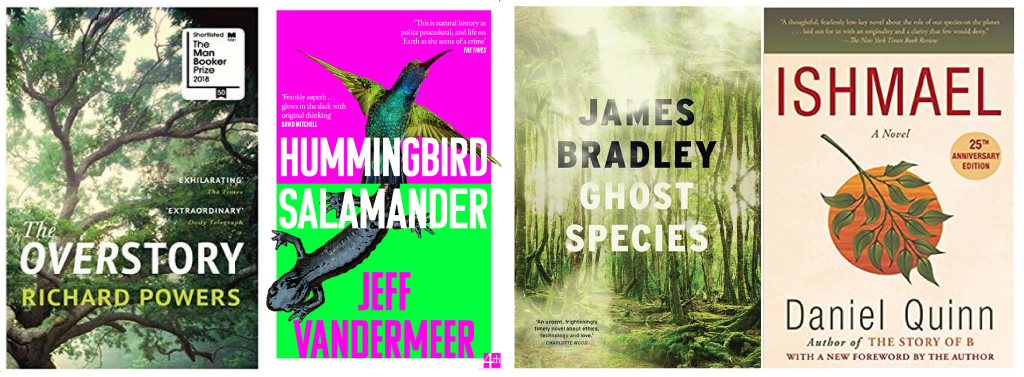


 Read For Life