Category: Cli-fi

  • Using Cli-Fi to Reframe Responses to Climate Change – Podcast

    Using Cli-Fi to Reframe Responses to Climate Change – Podcast

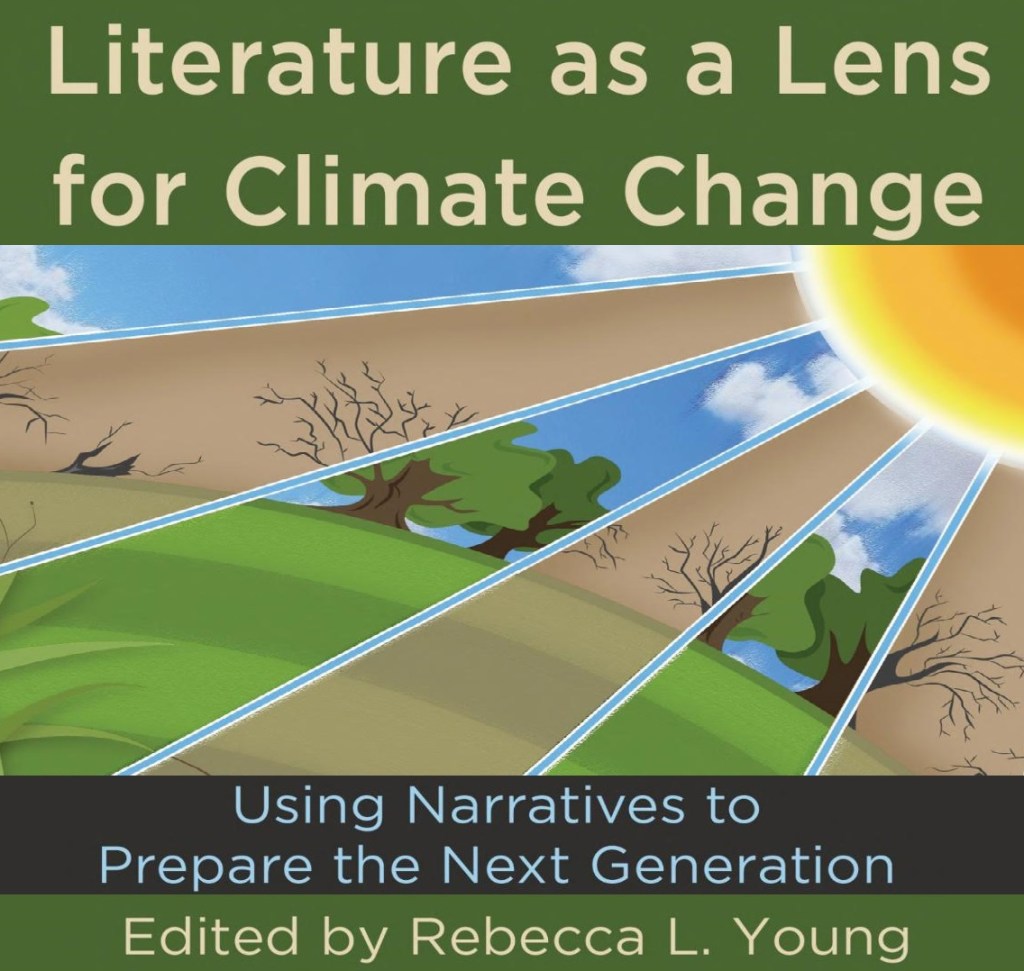
    My contribution to Literature as a lens for climate change (in 5 parts)
    Young, R. L. (2022). Literature as a lens for climate change : using narratives to prepare the next generation. Lexington Books.

    Listen here or Subscribe to Developmental Bibliotherapy Podcasts on Spotify

    Part 1 Introduction: Teaching Climate Change without Creating Despair or Entrenching Denial
    Part 2 Activism: Where Hope Rules
    Part 3 Harnessing the Power of Stories
    Part 4 Reading and Well-Being
    Part 5 Developmental Bibliotherapy and CLi-Fi
    References

    Albrecht, Glenn. 2012. “The Age of Solastalgia.” The Conversation. August 7, 2012. https://theconversation.com/the-age-of-solastalgia-8337.

    American Library Association. 2017. “Professional Ethics.” Tools, Publications & Resources. May 19, 2017. http://www.ala.org/tools/ethics.

    Andersen, Gregers, and Carsten Munk Hansen. 2014. “Fiction Prepares Us for a World Changed by Global Warming.” Humanities.ku.dk. University of Copenhagen. November 10, 2014. https://humanities.ku.dk/news/2014/fiction_prepares_us_for_a_world_changed_by_global_warming/.

    Bandura, Albert. 1978. “Self-Efficacy: Toward a Unifying Theory of Behavioral Change.” Advances in Behaviour Research and Therapy 1 (4): 139–61. https://doi.org/10.1016/0146-6402(78)90002-4.

    Cohen, Stanley. 2015. States of Denial : Knowing about Atrocities and Suffering. Cambridge, Uk: Polity ; Malden, Ma.

    Duggan, Joe. n.d. “This Is How Scientists Feel.” Is This How You Feel? Accessed June 25, 2021. https://www.isthishowyoufeel.com/this-is-how-scientists-feel.html.

    Eckersley, Richard. 2008. “‘Nihilism, Fundamentalism, or Activism: Three Responses to Fears of the Apocalypse’ by Eckersley, Richard – the Futurist, Vol. 42, Issue 1, January-February 2008 | Online Research Library: Questia.” The Futurist 42 (1). https://www.richardeckersley.com.au/attachments/Futurist_Apocalypse_2008.pdf.

    Edwards, Sarah Anne. 2008. “Eco-Anxiety: An Intelligent Response.” Eco-Anxiety. March 20, 2008. http://eco-anxiety.blogspot.com/2008/03/by-sarah-anne-edwards-phd-lcsw-articles.html.

    Gold, Joseph. 2001. Read for Your Life : Literature as a Life Support System. Markham, Ont.: Fitzhenry And Whiteside.

    Kelly, Claire M, Johanna M Mithen, Julie A Fischer, Betty A Kitchener, Anthony F Jorm, Adrian Lowe, and Chris Scanlan. 2011. “Youth Mental Health First Aid: A Description of the Program and an Initial Evaluation.” International Journal of Mental Health Systems 5 (1): 4. https://doi.org/10.1186/1752-4458-5-4.

    Konrath, S. H., E. H. O’Brien, and C. Hsing. 2010. “Changes in Dispositional Empathy in American College Students over Time: A Meta-Analysis.” Personality and Social Psychology Review 15 (2): 180–98. https://doi.org/10.1177/1088868310377395.

    Kringelbach, Morten L., and Kent C. Berridge. 2009. “Towards a Functional Neuroanatomy of Pleasure and Happiness.” Trends in Cognitive Sciences 13 (11): 479–87. https://doi.org/10.1016/j.tics.2009.08.006.

    Lilleslåtten, Mari , and University of Oslo. 2020. “Climate Change Impacts Nordic Literature – Department of Linguistics and Scandinavian Studies.” Www.hf.uio.no. March 5, 2020. https://www.hf.uio.no/iln/english/research/news-and-events/news/2020/climate-change-impacts-nordic-literature.html.

    Lopes, Lunna, Cailey Muñana, and 2019. 2019. “The Kaiser Family Foundation/Washington Post Climate Change Survey – Main Findings – 9349.” KFF. September 16, 2019. https://www.kff.org/report-section/the-kaiser-family-foundation-washington-post-climate-change-survey-main-findings/.

    Macmillan, Jade. 2021. “Deputy Prime Minister Flags Excluding Agriculture from 2050 Climate Target.” Www.abc.net.au. ABC. February 7, 2021. https://www.abc.net.au/news/2021-02-07/michael-mccormack-flags-excluding-agriculture-climate-target/13130160.

    Marsden, John. 2019. The Art of Growing Up. Sydney, N.S.W.: Pan Macmillan Australia.

    Merzian, Richie, Audrey Quicke, Ebony Bennett, Rod Campbell, and Tom Swann. 2019. “Climate of the Nation 2019 Tracking Australia’s Attitudes towards Climate Change and Energy.” https://australiainstitute.org.au/wp-content/uploads/2020/12/Climate-of-the-Nation-2019-WEB.pdf.

    Mission Australia , and Black Dog Institute. 2017. “Youth Mental Health Report : Youth Survey 2012-16.” Sydney, N.S.W.: Mission Australia. https://blackdoginstitute.org.au/docs/default-source/research/evidence-and-policy-section/2017-youth-mental-health-report_mission-australia-and-black-dog-institute.pdf?sfvrsn=6.

    Morehead, James. 2016. “Stanford University’s Carol Dweck on the Growth Mindset and Education.” OneDublin.org. OneDublin.org. April 18, 2016. https://onedublin.org/2012/06/19/stanford-universitys-carol-dweck-on-the-growth-mindset-and-education/.

    Noe, Alva. 2019. “NPR Choice Page.” Npr.org. 2019. https://www.npr.org/sections/13.7/2016/06/17/481977405/why-do-our-minds-wander.

    O’Brien, Karen, Elin Selboe, and Bronwyn M. Hayward. 2018. “Exploring Youth Activism on Climate Change:  Dutiful, Disruptive, and Dangerous Dissent.” Ecology and Society 23 (3). https://doi.org/10.5751/es-10287-230342.

    Oades, Lindsay G., Aaron Jarden, Hanchao Hou, Corina Ozturk, Paige Williams, Gavin R. Slemp, and Lanxi Huang. 2021. “Wellbeing Literacy: A Capability Model for Wellbeing Science and Practice.” International Journal of Environmental Research and Public Health 18 (2): 719. https://doi.org/10.3390/ijerph18020719.

    Olsen, Marci. 2006. “Bibliotherapy: School Psychologists’ Report of Use and Efficacy BYU ScholarsArchive Citation.” Scholars Archive. https://scholarsarchive.byu.edu/cgi/viewcontent.cgi?article=1408&context=etd.

    Ortiz, Diego Arguedas. 2019. “How Science Fiction Helps Readers Understand Climate Change.” Www.bbc.com. BBC. January 15, 2019. https://www.bbc.com/culture/article/20190110-how-science-fiction-helps-readers-understand-climate-change.

    Pew Research Center. 2019. “Most U.S. Teens See Anxiety and Depression as a Major Problem among Their Peers.” PEW Research Center. https://www.pewresearch.org/social-trends/wp-content/uploads/sites/3/2019/02/Pew-Research-Center_Teens-report_full-2.pdf.

    Richards Bodart, Joni, Ashley N. Barrineau, and Mary L. Flamino. 2011. “The Printz Award Winners under a Microscope: Content Trends, Committee Challenges, and Teen Popularity.” The Journal of Research on Libraries and Young Adults. Young Adult Library Services Association. http://www.yalsa.ala.org/jrlya/2011/02/the-printz-award-winners-under-a-microscope-content-trends-committee-challenges-and-teen-popularity/.

    Rubin, Rhea J. 1979. “Uses of Bibliotherapy in Response to the 1970s.” Library Trends 28 (2): 239–52. https://eric.ed.gov/?id=EJ212852.

    Stajkovic, Alexander D. 2006. “Development of a Core Confidence-Higher Order Construct.” Journal of Applied Psychology 91 (6): 1208–24. https://doi.org/10.1037/0021-9010.91.6.1208.

    Stark, Eloise A., Peter Vuust, and Morten L. Kringelbach. 2018. “Chapter 7 – Music, Dance, and Other Art Forms: New Insights into the Links between Hedonia (Pleasure) and Eudaimonia (Well-Being).” Edited by Julia F. Christensen and Antoni Gomila. ScienceDirect. Elsevier. January 1, 2018. https://www.sciencedirect.com/science/article/pii/S0079612318300190.

    The Australian Psychological Society Limited. 2019. “Young People’s Voices in the Climate Crisis.” https://psychweek.org.au/2019-archive/.

    UNICEF. 2016. “Environment and Climate Change.” Unicef.org. 2016. https://www.unicef.org/environment-and-climate-change.

    Verlie, Blanche. 2019. “Bearing Worlds: Learning to Live-with Climate Change.” Environmental Education Research 25 (5): 751–66. https://doi.org/10.1080/13504622.2019.1637823.

    Wakeman, Judith. 2019. “Activities & Printables.” Developmental Bibliotherapy. November 18, 2019. https://read4life.today/activities/.

    Wiessner, Polly W. 2014. “Embers of Society: Firelight Talk among the Ju/’Hoansi Bushmen.” Proceedings of the National Academy of Sciences 111 (39): 14027–35. https://doi.org/10.1073/pnas.1404212111.
  • Eco-Fiction – The SuperGenre Hiding In Plain Sight

    Eco-Fiction – The SuperGenre Hiding In Plain Sight

    When some of the earliest imagery created by humans depicts their interactions with their environment, it is astounding to think that Eco-fiction as a genre was identified and defined merely a few decades ago.

    Simply put, Eco-fiction portrays aspects of the natural environment and non-human life as an evolving entity with agency in its relationship between and interaction with human characters.

    Jim Dwyer in his preface to his book “Where the Wild Books Are: A field guide to Eco-fiction” quotes from Buell’s The Environmental Imagination (1995) when he writes:

    “My criteria for determining whether a given work is eco-fiction closely parallel Lawrence Buell’s:
    1. The nonhuman environment is present not merely as a framing device but as a presence that begins to suggest that human history is implicated in natural history.
    2. The human interest is not understood to be the only legitimate interest.
    3. Human accountability to the environment is part of the text’s ethical orientation.
    4. Some sense of the environment as a process rather than as a constant or a given is at least implicit in the text” [2]

    This criteria for eco-fiction could easily be satisfied in prehistoric cave art and in the dreamtime stories of first nations people who represent the landscape in songlines, and weave the behavior of animals into creation stories. Many readers will recall favorite stories from their childhood described by this genre – stories that warned us of the fragility of life, reinforcing our duty to respect and protect nature while invoking an empathetic attachment to anthropomorphized plants, animals and ethereal beings. Some may also remember stories that warned us of the dangers in harming non-human life, from Moby Dick to The Day of the Triffids.

    And yet Dwyer seems to marvel that the first use of the term Eco-fiction may have been the in the title of John Stadler’s 1971 anthology.

    Many have pointed out that Eco-Fiction can be considered as a supergenre. Elements of eco-fiction can be found in most, if not all genres, from mystery to romance, history to science fiction. Few readers would fail to recognise the elements of eco-fiction in Tolkein’s battle of Helm’s Deep between the Ents, symbolising the erstwhile peaceloving forest, and the Orcs, symbolising the destructive and polluting extraction industries. Eco-fiction is clearly represented in the non-human perspective described in T. H. White’s Once and Future King. And one cannot miss the fight against ecocide[3] foremost in The Word for World is Forest by Ursula Le Guin.

    More recently eco-fiction has overlapped with Cli-Fi to highlight not only how ecocide is both an accelerant for the effects of climate change and current mass extinction event, but is also an immoral act based on an assumption that the environment is to be exploited to serve an economy that feeds on progress.

    As Nina Munteanu[4] puts it “we are finally ready to see and portray the environment as an interesting character with agency”.

    Gregers Anderson identifies five elements present in Cli-Fi (Climate Fiction): Social Breakdown, Judgement, Conspiracy, Loss of Wilderness and The Sphere. Of these, Judgement (where recompense is administered by the natural world, and the environment evokes feelings of the uncanny, unfamiliar and uncontrollable) and the Loss of Wilderness (where the end of nature, with its peace and tranquillity, is akin to the eviction from paradise) are the typical outcomes of eco-fiction in contemporary Cli-Fi.

    Two recent studies[5][6] found that reading Cli-fi raises awareness and consciousness, increases knowledge, changes psychological distance (spacial and temporal), stimulates real world conversations[7], and invokes emotions with a sense that readers “eyes have been opened” and they have heard a “call to action”. The vivid imagery in these novels convert vague and abstract scientific concepts into something more concrete and recognisable than is possible by simply reading scientific reports and statistics. In Cli-Fi protagonists lamenting the action or inaction of previous generations from a possible future earth remind us of our responsibilities to future generations. It is likely that Eco-fiction influences readers in the same way.

    Eco-fiction can also serve as a way for children to engage with nature, regardless of their opportunities to engage with nature outside of the classroom, informing and teaching readers about the fragility, interconnectedness and importance of the natural environment, the vulnerability of ecosystems and the threats of human impact. Eco-fiction also offers readers the opportunity to engage with various forms and values of knowledge[8] and information, including ancient wisdom and first nations stories that encourage observation and wonder.

    A special aspect of YA Cli-Fi and Eco-fiction is that young fictional protagonists are speaking directly to their teen readers. When a character says “They knew. They didn’t think about the future did they? They never thought about us”[9] there is an almost tangible connection and an implicit demand to “assume responsibility via action”[10].

    It must also be noted that while responsible and trusted authors of fiction written for Young Adults must always leave their readers with hope, these young readers should always have access to a trusted adult with whom they can discuss any concerns. [11] But, as mentioned earlier, titles in this genre are more likely to stimulate the conversations that can mitigate anxiety through action. In situations where young readers are able to discuss novels which convey hopeful messages, Eco-fiction and Cli-fi can lead to a “heightened interest in environmental issues and a motivation to effect change.”[12]

    This essay is not an attempt to expand on the genre of Eco-Fiction, but rather to highlight how Eco-Fiction forces us to change our perception of the environment as a static literary prop – an entity that is “out there” – to an awareness and understanding of the earth’s ecosystems that are living, evolving and an essential aspect of life on this unique planet. Eco-fiction invokes the simulation heuristic – helping readers to imagine possible futures and consequences of inaction on climate change.

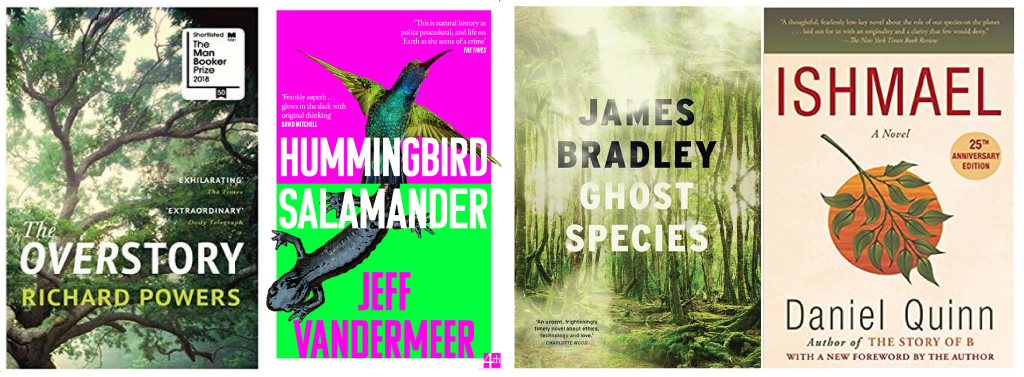
    The following titles are highly recommended as a starting point for senior secondary and adult readers.

    Ishmael by Daniel Quinn

    Hummingbird, Salamander by John Vandermeer

    Ghost Species by James Bradley.

    The Overstory by Richard Powers.

    See also:
    Read4Life Goodreads Ecofiction or visit Goodreads’ Eco-Fiction links


    [1] I have used this spelling of Eco-fiction to mirror that used by John Stadler in his anthology of the same name containing a selection of short stories including: A sound of thunder by R. Bradbury, The turtle by J. Steinbeck. The conversation of Eiros and Charmion by E.A. Poe, The fair young willowy tree by A.E. Coppard, A mother’s tale, by J. Agee, The law by R.M. Coates, The birds by D. du Maurier, A stay at the ocean by R. Wilson, Jr., The supremacy of Uruguay by E.B. White, Look how the fish live by J.F. Powers, Tomorrow and tomorrow and tomorrow by K. Vonnegut, Jr., The white heron by S.O. Jewett, The Mary Celeste move by F. Herbert, The toys of peace by Saki (H.H. Munro), The subliminal man by J.G. Ballard, It’s such a beautiful day by I. Asimov, The hummingbird that lived through winter by W. Saroyan.

    [2] Jim Dwyer. Where the Wild Books Are : A Field Guide to Ecofiction. University of Nevada Press, 2010.

    [3] Ecocide has not been accepted as an internationally punishable crime by the United Nations.  The only international recognition of ecocide is in the Rome Statute as a war crime where it is a crime to “Intentionally launch an attack in the knowledge that such attack will cause incidental loss of life or injury to civilians or damage to civilian objects or widespread, long-term and severe damage to the natural environment which would be clearly excessive in relation to the concrete and direct overall military advantage anticipated”.

    Despite repeated attempts to recognise ecocide as a threat to peace, in particular by Scottish Lawyer Polly Higgins in 2010 and more recently by Vanuatu and the Maldives in 2019, ecocide is not a crime in peacetime. Ecocide can be defined as “The extensive damage to, destruction of or loss of ecosystems of a given territory, whether by human agency or by any other causes, to such an extent that peaceful enjoyment by the inhabitants of that territory has been severely diminished”. This definition includes damage caused by individuals, corporations and/or the State. https://en.wikipedia.org/wiki/Ecocide

    [4] Munteanu, Nina. “Ten Eco-Fiction Novels Worth Discussing.” Tor.com, 10 Nov. 2020, http://www.tor.com/2020/11/10/ten-eco-fiction-novels-worth-discussing/. Accessed 16 June 2022.

    [5] Schneider-Mayerson, Matthew. “The Influence of Climate FictionAn Empirical Survey of Readers.” Environmental Humanities, vol. 10, no. 2, 2018, pp. 473–500, read.dukeupress.edu/environmental-humanities/article/10/2/473/136689/The-Influence-of-Climate-FictionAn-Empirical, 10.1215/22011919-7156848.

    [6] Lindgren Leavenworth, Maria, and Annika Manni. “Climate Fiction and Young Learners’ Thoughts—a Dialogue between Literature and Education.” Environmental Education Research, vol. 27, no. 5, 7 Dec. 2020, pp. 727–742, 10.1080/13504622.2020.1856345. Accessed 6 Nov. 2021.

    [7] In both studies the potential for stimulating discussions was noted and suggested for further study.

    [8] (Lindgren Leavenworth and Manni)

    [9]Bertagna, Julie. Zenith. London, Macmillan, 2011.p 207

    [10] (Lindgren Leavenworth and Manni)

    [11] Adult readers in the study reported feeling “inspired”, “motivated” and forced to “reignite concerns they had let go idle” but also “angry”, “incredibly sad”, “helpless” and “guilty”. Many reported a realisation that climate change was a “slow moving violence” that also encompassed widespread social, cultural and political repercussions.

    [12] (Lindgren Leavenworth and Manni)

  • READ4LIFE Podcasts

    READ4LIFE Podcasts

    Listen to Developmental Bibliotherapy as a podcast…

    Or Listen on Spotify

    Developmental Bibliotherapy: A Quick Introduction
    Cli-Fi: Reframing Young People’s Responses
    to Climate Change
    Chance and the Prepared Mind

    Photos by Juja Han and Nick Fewings on Unsplash