
Implementing Developmental Bibliotherapy…
Developmental Bibliotherapy occurs when Young People recognize that a change has taken place in their thoughts, feelings, actions or beliefs.
Developmental Bibliotherapy Activities can take as little as five minutes or can be developed into a unit of work.
Activities should encourage Discussion on significant characters or events in a story.
Developmental Bibliotherapy on PREZI
Requirements:
- Well written age appropriate novels (Graphic Novels are OK)
- Trusted adults – Ideally the Classroom Teacher & Teacher Librarian
- Class Time & Commitment
Core elements:
- Each student must have read a suitable book or Graphic Novel.
- Facilitators stimulate discussion & sharing with
individuals &/or groups during the reading stage. - Followup activities & discussion questions are carefully
designed to promote self reflection.
Character attributes:
Introduce Character Attributes as a class discussion – the depth of discussion will depend on student maturity, time, and other factors including school culture.
Research has demonstrated that character encompasses a multitude of strengths that can be organized into three dimensions:
- Interpersonal strengths, like gratitude, enable harmonious relationships with other people;
- Intrapersonal strengths, like grit and self-control, enable achievement; and
- Intellectual strengths, like curiosity, enable a fertile and free life of the mind.
The Character Attributes you decide to explore will depend somewhat on the age of the group. Programs focusing on Developing Character may already be part of a wider school program. Alternatively you can create your own list of attributes to discuss, perhaps even with the assistance of the group. Introduce these ideas gradually with examples if time permits.
Younger groups might consider…
Gratitude, Courage, Kindness, Generosity, Creativity and Curiosity.
Older groups might look at …
Hope, Optimism, Resilience, Self Efficacy, , Compassion, Empathy, Grit, Self control, Curiosity, Creativity and Generosity.
More ideas can be found on these pages:
Stajkovic’s Core Confidence – Optimism, Hope, Self-efficacy & Resilience
Seligman’s 24 Signature Strengths at VIA Character Lab
 | 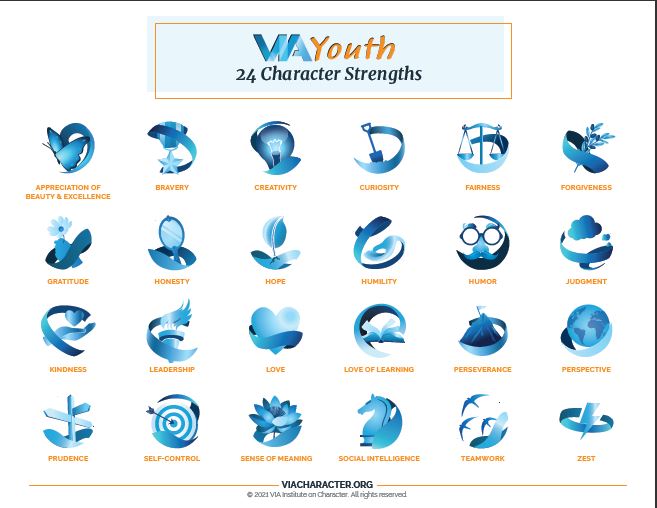 | 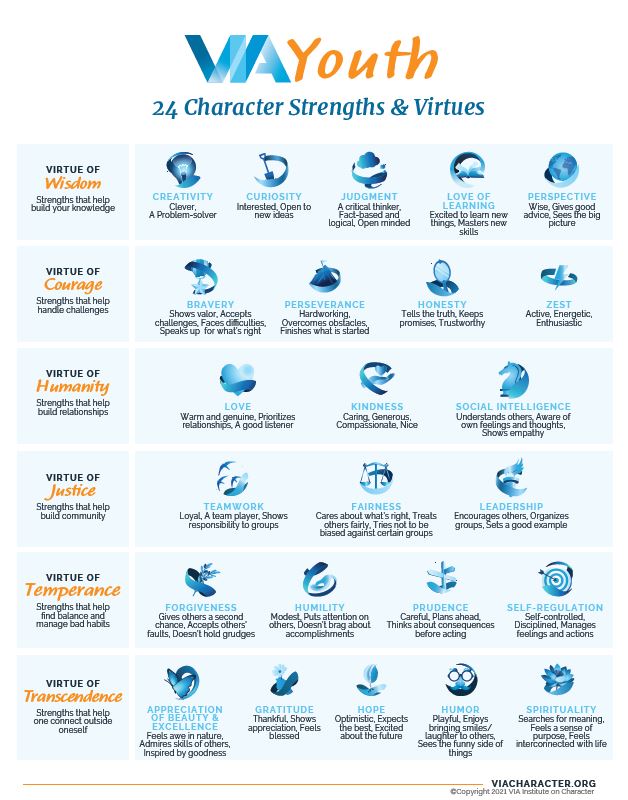 |
Download here or go to the website to learn more.
Outcomes:
Developmental Bibliotherapy Programs, whether delivered formally or informally should produce the following outcomes in the young adult participants:
More…
- Core confidence – Resilience, Optimism, Hope and Self-Efficacy.
- Empathy, Compassion, Discussion, Tolerance, Openness,
- Awareness & Support for those experiencing mental illness themselves or caring for someone with a mental illness.
- Better Mental Health Outcomes by minimizing barriers to Early Intervention
Fewer…
- Stigmas, Stereotypes, Fears associated with Mental Illness.
- Incidents of Aggression & Bullying in classrooms.
- Lives disrupted due to mental illness.
Reading for Wellbeing Booklet 2018
Activities
Questions, Questions, Questions

Have a few Open Ended Questions ready for Informal Conversations…
Print questions onto Cards and have students pick one to Ponder, Discuss, as a basis for a Book Review or to bring the class together at the end of the lesson.
Questions should be Conversation Starters (not essay topics)
– there are No Wrong Answers.
For Printable Questions (in list or table form for cards) see Printables section below.
Suggested Questions can be grouped into Characters (CQ), Storylines (SQ), Author (AQ) related and Self Reflection (SR). A few Preliminary Questions have been included as Ice Breakers.
Questions are also marked with a subjective “Difficulty” star rating as a guide to reflect the complexity of the answer you might expect from your readers.
Conversation Starters – IF… (Cards)
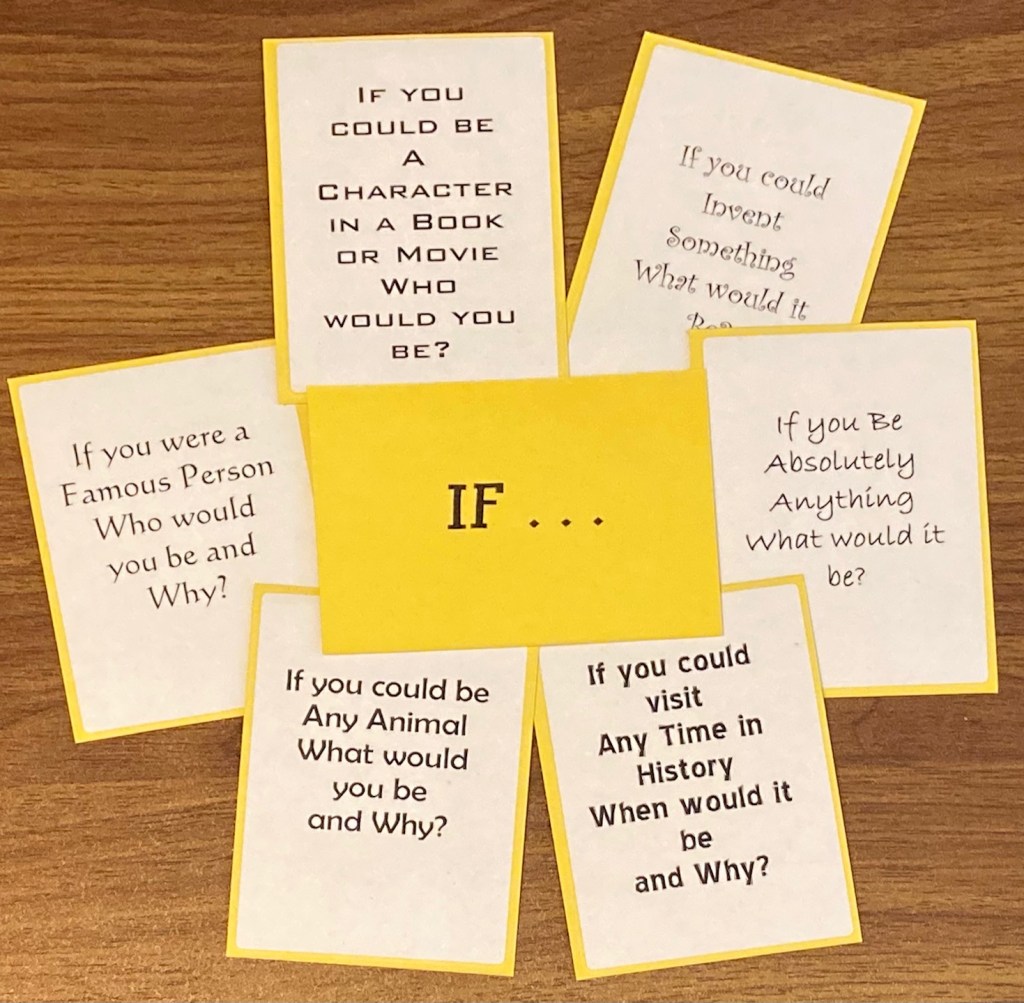
The IF… set of cards can be also used be used as an informal discussion starter, a Circle Chat idea, stimulus for an art project or a starting point for a book search.
See Printables section for a card layout..
Other Activities

Literary events can be a starting point for Developmental Bibliotherapy if there is an element of self reflection, such as a conversation, about their choice.
Encourage students to Explain Their Choice of Costume, Diorama, Play, Book Trailer, Bookposter, Book Review …
Try Speed Booking (Instructions below)
Use Weapon of Choice to reveal book recommendations.
In the Printables you will find 3 templates to chose from.
Quotations

Choosing Meaningful quotes can help readers identify special messages that the author wants to share.
Collecting Quotes also helps readers identify which parts of the text are Meaningful for Them.
Bookmark & Tag Templates (see Printables below )can be used to record meaningful quotes on the reverse as they come across them.
The Weapon of Choice Activity (see Printables) could be a way to reveal favorite quotations – with a reminder to include Title and Author.
Note: It does not matter where students find their Quotation; only that the quotation has meaning for them.
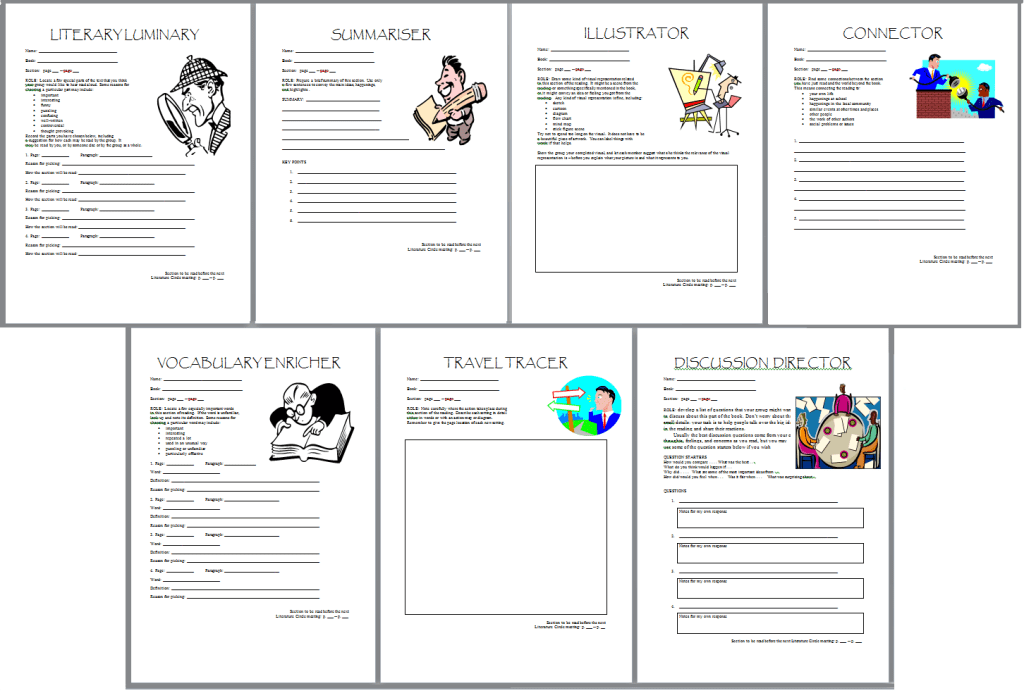
Literature Circles

Literature Circle Programs are ideal for incorporating
Developmental Bibliotherapy into Library Reading Programs.
Small groups of students work through set activities over a number of weeks as they read through the books they have selected.
For an Instruction and Activity booklet from Darryn Kruse see Printables.
Key points for Literature Circles:
- Children choose their own reading materials.
- Small temporary groups are formed, based on book choice.
- Different groups read different books
- Groups meet on a regular predictable schedule.
- Students use written or drawn notes to guide both their reading and discussion.
- Discussion topics come from the students
- Group meetings aim to be open, natural conversations. Often the conversations digress to topics relating to the students or loosely to the books, but should eventually return to the novel.
- The teacher serves as a facilitator, observer, listener and often a fellow reader, alongside the students. The teacher is not an instructor.
- Students are given roles or jobs to complete for each group meeting.
- The teacher should model how students should facilitate each role or job.
- Evaluation is by teacher observation and student self-evaluation and should also include extension projects.
- A spirit of playfulness and fun pervades the room.
- New groups form around new reading choices.
(Daniels, 1994) as cited in https://en.wikipedia.org/wiki/Literature_circle
It is important that the questions and activities encourage self reflection.
Printables

Questions Questions Questions
List Format (pdf),
Listformat (doc)
Table Format (pdf)
If … Cards


Speed Booking – Instructions
CANITBEFORME Bookmarks

Weapon of Choice Templates (3 options)

 Read For Life